



April 13, 2026, 2:32 pm | Read time: 3 minutes
In many places, the expansion of fiber optics is steadily advancing. The new development aims to provide particularly fast and stable internet to meet ever-growing demands. However, while this is expected to improve things for consumers, security experts are sounding the alarm. Fiber optic cables could also be misused for espionage.
Fiber Optic Cables Sensitive to Sound Waves
As “Cyber Security News” reports, researchers presented their findings at this year’s Network and Distributed System Security Symposium (NDSS) in San Diego, California. Their work focuses on the fact that fiber optics are very sensitive to acoustic vibrations—a characteristic that has been underestimated in the otherwise secure communication with fiber optics.
As a result, savvy attackers could use fiber optic cables for espionage by turning them into microphones. When sound waves hit the fiber, they cause microscopic structural deformations in the cable, leading to detectable changes in the light signal traveling through it.
By using a commercially available DAS (Distributed Acoustic Sensing) to locate and analyze sound sources and connecting it to just one end of the cable, an attacker can reconstruct the original sound wave from the other end over a distance of more than 50 meters.
Fiber Optic “Microphones” Easy to Hide
This is just the foundation. To truly spy via fiber optic cables, the security researchers also crafted a special “sensory receptor.” This involves a hollow plastic cylinder with a diameter of 65 millimeters, around which 15 meters of fiber optic cable are tightly wound.
Also interesting: Fiber Optic ABC – Key Information About Internet Connections
The cylinder acts as a kind of amplifier for acoustic pressure changes, significantly enhancing the ability to record sound. Additionally, the report states that the cylinder can be disguised as a junction box. While this would require access to homes and apartments, technicians and service providers often gain such access quite easily.
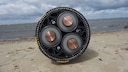
How Does a Digital Undersea Cable Work?

Amazon Echo Studio (2025) Review–New Look, Better Sound
Not Just Theory
The explanations are not purely theoretical. In fact, the experts have already tested their method practically—with sensational results. At a distance of less than two meters, they were able to transcribe spoken language with 80 percent accuracy, aided by speech recognition AI programs like OpenAI Whisper or NVIDIA Parakeet.
The accuracy increased to 91 percent in a “real office scenario” with two rooms and 50 meters of fiber optic cable between them when the box was placed directly under a table. Additionally, the experts could even determine the location of a speaker in the room with an average accuracy of 77 centimeters. Other sounds like typing, coughing, or alarm signals were recognized with 83 percent accuracy.
Also interesting: How Easily Wi-Fi Can Become a Spy
What Can Be Done About It
Also concerning: Fiber optic sensors operate without electricity and emit no radio waves, making them invisible to standard control and monitoring measures. Even an ultrasonic jammer, which is otherwise effective against bugs, showed no significant degradation in speech recognition—even when the jammer was only ten centimeters away.
No cases are yet known where someone has repurposed fiber optic cables for espionage. Nevertheless, this now poses a real threat, especially for businesses or government buildings. To protect against this, optical isolators should be installed, and optimal cable routing within rooms should be ensured. The cables should not touch resonant surfaces like walls or tables. Sound-dampening materials are recommended where the cables run. Furthermore, polished fiber connectors are advantageous as they can create Fresnel reflections, which can cause failures in DAS usage.