

February 20, 2023, 10:12 am | Read time: 5 minutes
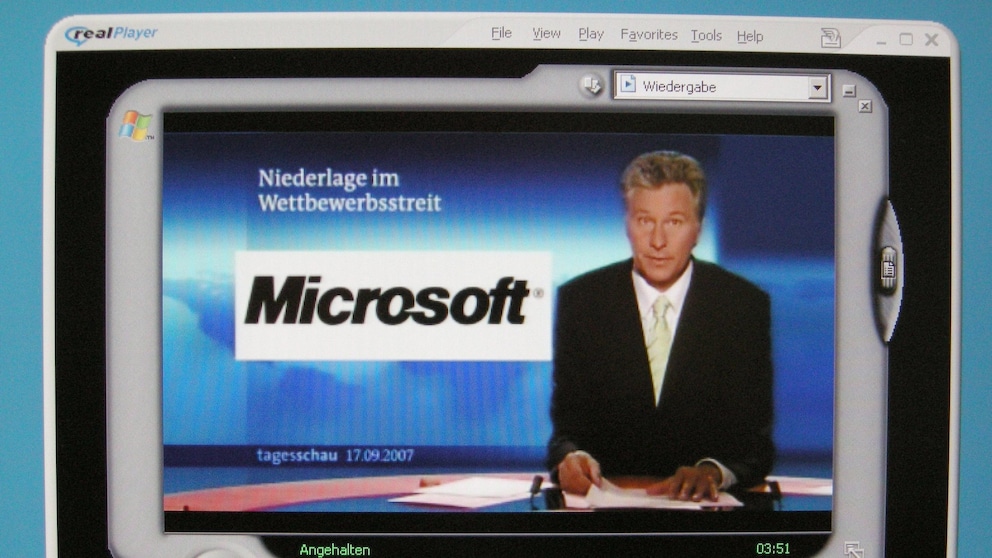
Streaming has become an indispensable part of our daily lives. Many probably still remember the RealPlayer, which is considered a pioneer of Netflix, Spotify, and others. But what actually happened to the program?
Want to quickly catch the latest concert of your favorite band via livestream? Or binge-watch the new season of your favorite series on Netflix over the weekend? Today, that’s no longer a problem, but in the early days of the internet, things were different. Streaming, which is the real-time transmission of media from one computer to another, has been technically possible since the mid-1970s. A first streaming standard was defined in the mid-1990s by RealPlayer, the mother of all streaming services.
When digitalized speech was first transmitted from one computer to another in 1974, the internet was still called ARPANET. The abbreviation stands for Advanced Research Projects Agency Network. Since then, developers have dreamed of transmitting music, movies, concerts, or other events in real-time over a data line.
It wasn’t until the late 1980s that the first computers capable of receiving streams came onto the market. However, the available bandwidth at that time was still insufficient to achieve stable media transmission.
Radio on the Computer?
Robert Glaser started working at Microsoft in 1983. The computer science graduate loves radio. As a teenager, he was involved in setting up a school radio station at his high school. In 1993, he learned about the Mosaic browser, the first internet browser capable of displaying graphics and other interactive elements. Subsequently, Robert Glaser left Microsoft to pursue his new passion. In early 1994, he founded the IT company Progressive Networks. It took a little over a year for the company to launch its first product: the Real Audio Player.
With the free software, music could be streamed and listened to on a computer. The Real Audio format made it possible despite the extremely slow modem transmission of 14.4 kilobits per second or 0.0000144 gigabits per second. A modern internet connection can achieve up to 1 gigabit per second. The sound quality left much to be desired, but there was great excitement about being able to transmit and receive media via streaming at all.

What happened to Napster, Second Life and Co.

How a German Researcher Is Building the Internet of the Future
First Livestream via RealPlayer
Encouraged by this first streaming milestone, Progressive Networks continued to develop the RealPlayer. In September 1995, they successfully livestreamed the baseball game between the Seattle Mariners and the New York Yankees over the still-young internet. Although the stream broke off shortly before the end of the game, the response in the computer world was tremendous.
From then on, RealPlayer was considered the gold standard in streaming. Neither Microsoft nor Apple had a similar product on the market at that time. In 1997, Progressive Networks released the Real Video format. Due to high data compression, it was now possible to stream the then very popular music videos. Although the quality did not yet match the videos on MTV, music fans around the world enjoyed the streaming experience via Real Player.
By then, Robert Glaser had changed the name of his company to Real Networks. In November 1997, Real Networks even went public on Wall Street. The triumph of the RealPlayer seemed to continue unabated. However, major competition in the form of Microsoft was already looming on the horizon.
Read also: Microsoft removes Internet Explorer from Windows PCs
Dotcom Bubble, Windows 98, Flash
With Windows 98, a completely revised version of the Media Player was also released. At that time, about 85 percent of the media available online was still in Real format. However, the massive spread of Windows 98 and the pre-installed Media Player soon changed the balance of power.
Rumors began to circulate that RealPlayer contained so-called spyware. This was a tool that collected information without consent and sent it to the manufacturer. It was said that RealPlayer listened in on what music was being played on a user’s computer. The music titles were then allegedly transmitted to Real Networks by the spyware. This caused quite a stir at the time. Today, in the era of Google and Facebook, such a “scandal” might not even be newsworthy. Real Networks tried to combat the negative image and emerging competition with exclusive premium offerings, such as videos from CBS, the BBC, Al Jazeera, and Ministry of Sound. Nevertheless, the star of RealPlayer began to wane. The first internet crisis in 2000, the dotcom bubble, accelerated the decline of Real Networks.
Meanwhile, online media increasingly relied on the Flash format from Macromedia for streaming. In 2005, a newly founded video portal called YouTube also trusted this format. By this point, RealPlayer had finally faded into obscurity. However, the software and the associated Real format are not dead. Perhaps it’s even a twist of fate, as RealPlayer can now be used to download YouTube videos to one’s own computer. At least a small consolation for the streaming pioneer.