


July 15, 2026, 10:47 am | Read time: 6 minutes
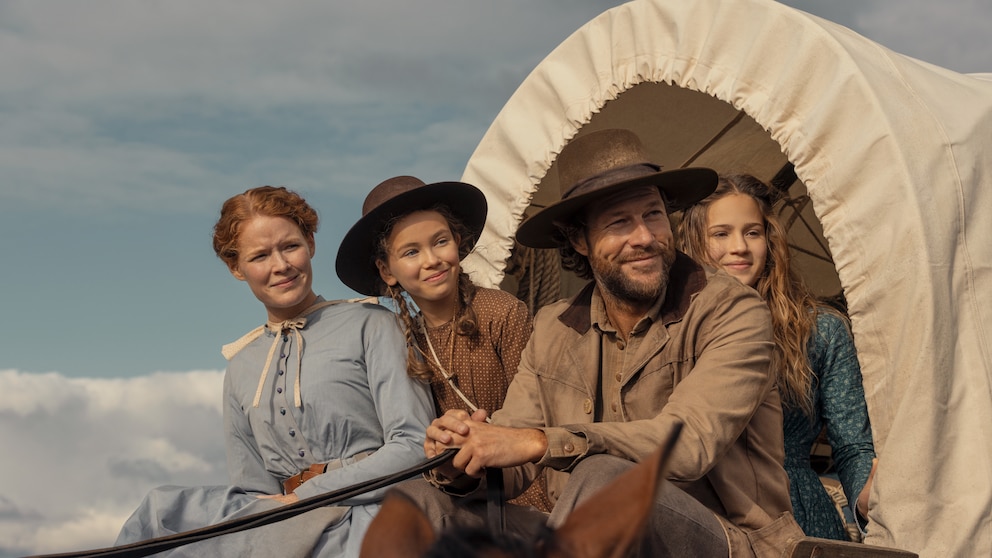
There are series that have shaped generations—even if they were never considered great television art. “Little House on the Prairie” is one of them. The series, which aired between 1974 and 1983, was never perfect, but it took time for its characters, for quiet and loud moments, and for family life. That’s exactly what’s missing in the new Netflix version.
However, the remake does have its strengths. It doesn’t just retell the story but is more closely aligned with the autobiographical books by Laura Ingalls Wilder. This is evident from the setting: Instead of starting directly in Walnut Grove like the original, the series begins in Independence, Kansas—where the Ingalls family actually first settled. This is closer to the autobiographical books by Laura Ingalls Wilder and at the same time more historically credible than the TV series.
Laura is the Real Focus
Anyone expecting a modern version of the old TV series will quickly realize that Netflix sets a different focus. The main focus is on Laura and her sister Mary. Laura, in particular, carries the plot almost single-handedly over long stretches.
This works surprisingly well. Laura is curious, headstrong, and portrayed as significantly more complex than many other characters. The young protagonist manages to carry the series repeatedly. At the same time, this shifts the balance of the story. From a family series, it increasingly becomes Laura’s story.
Also interesting: Netflix Brings “Little House on the Prairie” Back! Trailer Offers a Glimpse into the Remake
Charles and Caroline Lose Their Luster
This is particularly evident with the parents: Charles Ingalls was much more than just the family father in the original. Michael Landon played him as the moral compass of the series. He made mistakes, doubted, and occasionally failed—but always remained a character with clear values and enormous charisma. Little of that remains in the Netflix version. Charles often seems passive and surprisingly bland. Decisions seem to be determined more by the plot than by his personality. The emotional center of the family is lost as a result.
Access to Caroline Ingalls is even more difficult. While she embodied warmth, strength, and cohesion in the original, she often seems cold and almost unsympathetic in the remake. Although Caroline visibly changes by the end of the season, this transformation occurs so suddenly that it is hardly comprehensible.
Of course, a modern interpretation can portray characters with more edges. But here, the feeling of a family whose cohesion withstands all crises rarely arises.
Eight Episodes Just Aren’t Enough
The biggest problem with the series lies elsewhere: in its pacing. Netflix tells about two years of the family’s life in just eight episodes. Events follow one after another. Conflicts arise and are often resolved just a few minutes later. Emotional highlights hardly have time to unfold their impact. Even significant events, which in the original would have carried entire episodes, are often dealt with in just a few minutes here.
Yet the detailed, sometimes meandering storytelling was always the great strength of “Little House on the Prairie.” Many episodes thrived on small encounters, quiet conversations, or moments when seemingly little happened. This calm is almost impossible to find here. Instead, the series often seems to be ticking off a checklist of important events. This may cater to modern viewing habits but takes away the story’s emotional depth.
Good Characters Remain Unused
The series repeatedly shows the potential it holds. Several supporting characters are introduced in an interesting way and pique curiosity. But just as you start to become interested in them, they fade into the background again. Many characters simply receive too little screen time to truly develop contours.
Especially in a story that thrives on community and interpersonal relationships, this is particularly unfortunate.
Not Always Historically Accurate–But Closer to the Books
Anyone familiar with the real history of the Ingalls family will also discover numerous changes. The chronological order of many events does not match the historical models. Particularly striking is Laura’s age: The family actually lived near Independence, Kansas, from 1869 to 1871—Laura was only between two and four years old at the time. In the Netflix series, she is significantly older so that she can carry the plot as a central character.
Nevertheless, the remake seems more authentic in some places than the TV series from the 1970s. Among the most successful changes in the Netflix adaptation is the portrayal of the Osage. Unlike the original series, it clearly shows that the Ingalls family settled on land that belonged to the Osage and should not have been occupied by white settlers. This makes the conflicts more understandable and historically credible. The series largely avoids simple good-and-evil depictions and makes it clear that the tensions mainly arose from the settlers’ land appropriation.

Netflix Brings “Little House on the Prairie” Back! Trailer Offers a Glimpse into the Remake

Cult Anime Gets a Remake: “Can’t You Think of Anything New?!”
Between Vastness and Studio Look
Visually, the remake also leaves a mixed impression. While Netflix captures the vastness of the prairie with atmospheric landscape shots and a successful play of light and shadow, many settings seem surprisingly artificial. For long stretches, the action takes place in just three locations: the Ingalls’ farm, the small settlement of Independence, and the house of the Osage family Mitchell.
The locations often feel cramped and frequently convey the impression of a studio production, rather than creating a believable pioneer settlement. As a result, some of the atmosphere is lost, which made the original seem more authentic despite its significantly older age.
For Me, a Missed Opportunity
The Netflix remake of “Little House on the Prairie” is not a bad series. And even those familiar with the original will likely find many of the eight episodes quite entertaining. However, as a reinterpretation of a classic, it still falls short of its potential for me. Too many characters remain bland, Charles and Caroline lose their significance, and the fast-paced storytelling prevents emotional moments from truly resonating.
In the end, a modern series about Laura Ingalls and her family emerges—but not the slow-paced, richly detailed family portrait that made “Little House on the Prairie” a television classic for decades.