


September 13, 2025, 2:45 pm | Read time: 8 minutes
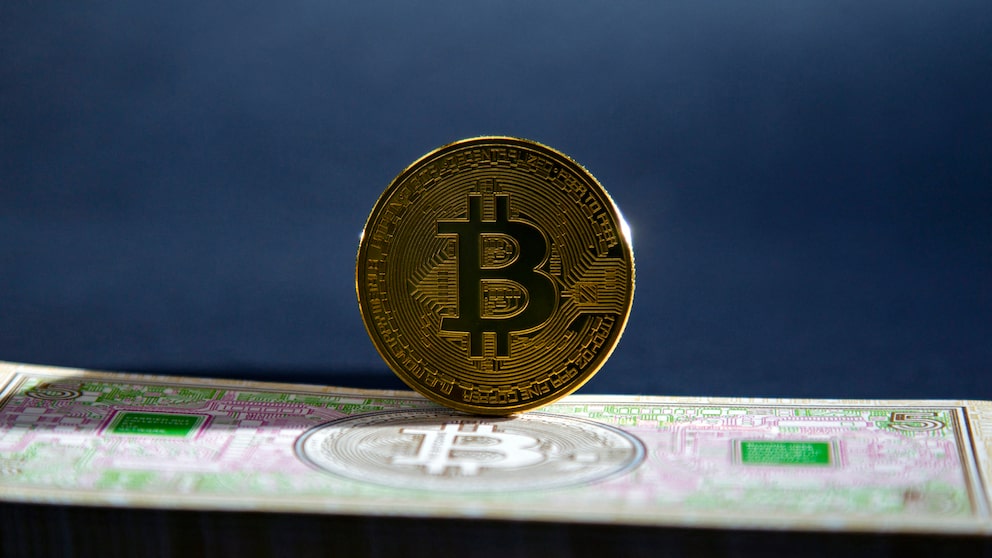
Bitcoin is probably the most well-known cryptocurrency. It is also the first of its kind and operates without a central bank or controlling authority. Since its introduction, Bitcoin has experienced significant ups and downs. TECHBOOK explains what you should know about Bitcoin.
Bitcoin first emerged in 2007. The founder of the first and now most widespread digital currency is Satoshi Nakamoto. However, the true identity behind this pseudonym remains unclear. Initially, cryptocurrency was more of a niche product for adventurous investors. Today, Bitcoin and others have become mainstream. However, the price can fluctuate significantly.
In December 2017, Bitcoin crashed from its then-high of more than 16,000 euros to under 6,000 euros. Many predicted the end of the boom at that time. Afterward, the digital currency went quiet. Three years later, at the end of 2020, Bitcoin suddenly surged again. Since then, the cryptocurrency has repeatedly reached peak values. The highest price in 2021 was over 65,000 euros, in 2022 over 42,000 euros, and in 2023 around 41,000 euros. In 2024, the 100,000-euro mark was even broken. This is reason enough to take a closer look at Bitcoin.
Overview
Bitcoin is a so-called cryptocurrency, a virtual currency that uses cryptography (encryption) to secure transactions. It aims to eliminate problems caused by today’s banking systems: When we use money to pay online, we need a middleman like a bank to ensure the money is real and reaches the recipient.
This requires us to trust the bank and results in all transactions being centralized there. However, this is also the weak point: The bank is the only one that can ensure payments are made and no double bookings occur. If the bank falls victim to a hack, the entire system is at risk.
With a decentralized cryptocurrency, you no longer need a bank. Each participant in the Bitcoin network receives an encrypted copy of a complete transaction history, essentially a file with information on which amount was transferred from A to B. Specific names or other sensitive details are, of course, not visible to everyone. Since every user automatically monitors the system, any attempt to manipulate the network is quickly detected and prevented. Another advantage is that no single person, bank, or government can control the flow of money. This makes it easier, faster, and cheaper to transfer money, even across national borders.
In recent years, numerous institutional investors have entered the crypto market. In January 2024, the U.S. Securities and Exchange Commission (SEC) finally approved so-called Exchange Traded Funds (ETFs). For investors, the introduction of spot ETFs on Bitcoin offers the advantage of investing in the cryptocurrency without acquiring it directly.
The Interaction of Bitcoin and Blockchain
The blockchain is the fundamental building block that guarantees the security of the Bitcoin currency. Essentially, it is a complete and chronological list of all transactions made in Bitcoin. New transfers are always added to the list in blocks, with each transaction block containing a record of previous blocks. This forms a chain of blocks, hence the term blockchain. Since each block always contains references to earlier blocks in the chain, it is extremely difficult for fraudsters to insert a false block with no or few references to previous transactions into the network.

The references are bundled in a block until the block reaches the intended size of 1 megabyte. However, the new block is not simply added to the chain; the network must first “certify” it. To verify it, network members must solve a kind of guessing game that can only be solved with a lot of computing power.
The Hash Value
The guessing game involves each block having a so-called hash value that the network must guess. The hash value of the block is essentially a longer code of letters and numbers, composed of the details of the transfers it contains and the hash value of the preceding block. It is unique for each block and looks something like this:
The computers of the members in the Bitcoin network must randomly generate hashes until one finds a value equal to or lower than the hash value of the block to be added. The solution takes an average of 10 minutes. This time span is set to ensure that a large part of the network can actually receive the block. Since the network is distributed worldwide, information reaches members at different speeds. The security of a transfer can only be guaranteed if as many members as possible vote on its authenticity. The 10 minutes are maintained by the system automatically adjusting the difficulty of the hashes. If more members with more powerful computer hardware join the network and can guess hashes faster, the difficulty level automatically increases. Conversely, the difficulty decreases if there is suddenly less computing power in the network.
Read also: Major banks launch blockchain offensive with their own crypto projects

How Blockchain Works: A Simple Explanation

What Bitcoin Halving Is All About
Bitcoin Mining Requires a Lot of Computing Power
But what is all this actually good for, and how do I get Bitcoins from it? Currently, members of the Bitcoin network receive a small fee as a reward if they are the first to guess the correct hash. The fee is deducted from a Bitcoin transfer and therefore does not change the total value of Bitcoins in circulation. Additionally, there is a second reward: new Bitcoins that are practically generated out of thin air. These new Bitcoins are intended not only to provide an incentive to become part of the network but also to ensure that no shortages occur. The reward was initially 50 Bitcoins in 2009 and has been halved every 210,000 transaction blocks since then. In 2012, the reward dropped to 25, in 2016 to 12.5, and in 2020 to 6.25. The last halving occurred in April 2024 from 6.25 to 3.125 Bitcoins. The next Bitcoin Halving is scheduled for 2028.
What Exactly Is Mining?
This entire process–earning Bitcoins by using your computer to guess hashes–is called mining and requires enormous computing power. Originally, simple PCs were sufficient for mining by using the power of processors and graphics cards to generate hashes. However, with the increased difficulty of the hashes, more and more power is needed to be the first to guess a target hash. Modern graphics cards have proven to be very effective, as they have a significantly higher hash performance than processors.
Given the relatively high electricity prices in Europe and the scarcity of graphics cards, it is now hardly profitable to mine on your own PC. Only PCs with multiple graphics cards that work around the clock or hardware specifically developed for mining (ASIC) can still yield a profit.
Altcoins, Faucets, Cloud: Alternatives to Bitcoin Mining
Instead of trying to mine Bitcoin alone, it can be profitable to join a so-called mining pool. In a mining pool, all participants contribute the power of their computers, which is then collectively used to solve transaction blocks. When the pool solves a block, the proceeds are distributed to the participants according to the share of power they contributed to the solution. With the combined power, it can even be profitable in certain cases to mine with your own PC.
Faucets
A very straightforward, but not very lucrative method to obtain Bitcoin is through so-called faucets. These are websites where you simply enter your own Bitcoin address and receive a small amount in return.
Cloud Mining
If you are willing to invest money in Bitcoins, you can try your luck with cloud mining. Here, you pay for a certain amount of computing power, the yield of which then benefits your account. There are sites like CryptoCompare, which can calculate exactly how much Bitcoin you can receive with a certain hash power.
Altcoins
Another option is to trade with other cryptocurrencies. There are numerous alternative coin currencies–called altcoins–that can sometimes quickly increase in value. The altcoins Ethereum and Litecoin are widespread, but there are countless others, including the satirical currency Dogecoin. Those who invest in these currencies at the right time can potentially achieve a substantial profit margin and then invest in Bitcoin.
All tips and information mentioned in the text do not constitute investment advice or a recommendation to buy or sell securities (§ 85 WpHG).