


August 3, 2024, 11:38 am | Read time: 5 minutes
If you pay with PayPal or Apple Pay on Lieferando, you might have noticed a new extra fee recently. TECHBOOK explains the background.
When your stomach growls and there’s nothing in the fridge, you can order a delicious meal from a food delivery service. Quickly choose the right dish online, pay conveniently and easily, and enjoy it shortly after. However, if you pay on Lieferando via PayPal, Apple Pay, or other methods, you have to pay an additional fee for some time now. While there is a specific reason for this, the question arises whether this is even allowed. The situation is not so clear-cut.
Lieferando Fee Due to PayPal and Apple Pay Surprises
A quick look at the bill after ordering and paying on Lieferando with PayPal or Apple Pay reveals so-called transaction costs of 0.29 euros. This may seem quite low, but over time, these can add up to a significantly higher amount.
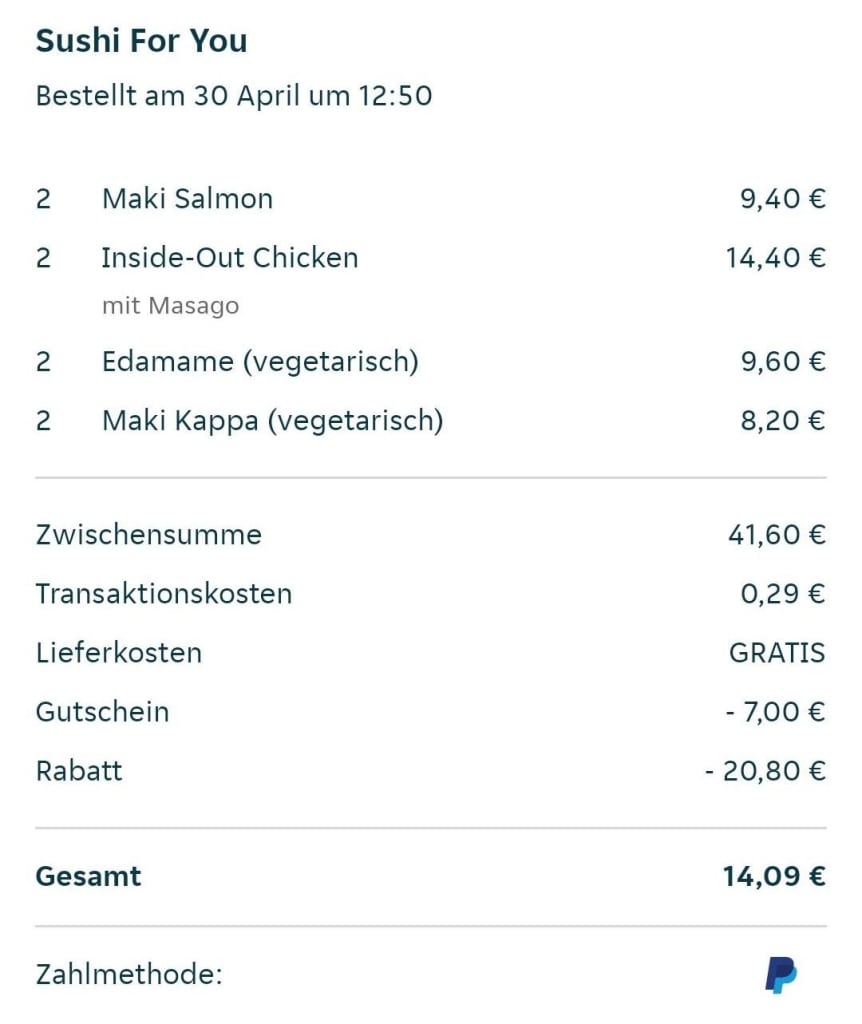
As user contributions on platforms such as Reddit or LinkedIn show, this fee also applies to payments via Google Pay and Klarna and even by instant transfer. Credit cards, however, are said to be exempt from the additional transaction fee.
This Could Be the Reason for the Additional Costs
There is no official explanation for the transaction costs yet. TECHBOOK asked Lieferando and received the following response:
“Customers can choose between cash payment and a variety of payment methods. Lieferando charges a payment fee when the payment is not made directly from a payment method such as a credit card, but via a payment service provider as an intermediary between the customer’s payment method and Lieferando.”
The statement is not very informative, especially since many customers are likely to use alternative payment services by now. According to the “Consumer Insights Report” by Statista, Lieferando is the most frequently used delivery service in Germany with 76 percent. In its own report, Lieferando mentions 15 million customers in Germany (as of 2022). If only a fraction of these paid via PayPal, Apple, or Google Pay, it would mean significant additional revenue for the company.
However, it is conceivable that Lieferando itself incurs additional expenses due to the integration of PayPal, Apple Pay, and others. For example, with PayPal, business owners have to pay fees for each transaction. The amount depends on various factors. Within the EU, these are usually 1.9 percent of the price plus 0.35 euros. To recoup these, the delivery service seems to pass the costs on to customers in the form of the transaction fee.
Also interesting: Lieferando now also delivers consoles and games
Is Lieferando Allowed to Charge Transaction Fees?
According to a ruling by the Federal Court of Justice (BGH) in 2021, such fees are generally permitted, as additional services are incurred through the use of such payment companies. However, PayPal’s own terms and conditions prohibit merchants from exactly this practice. It states in detail: “As a merchant, you may not charge your customers any surcharges or ‘service fees,’ higher shipping costs compared to other payment methods, or other fees for using PayPal services. Charging surcharges is a prohibited activity.”
Whether PayPal can enforce its own terms against Lieferando remains to be seen. According to “Finance Forward,” there are already talks between PayPal and Lieferando.
PayPal is currently offering a €10 credit to select users.

Beware of PayPal Scams in Classified Ads
What a Lawyer Says
TECHBOOK inquired with a law firm about the legal situation. As attorney Christian Solmecke informs us, PayPal is allowed to charge fees to Lieferando. “At least when the additional fee is not for the use of a specific payment method, but for the involvement of a third party, in this case, PayPal.”
The food delivery service “is not even in a gray area – it is clearly violating PayPal’s terms and conditions by passing the costs on to customers.” However, Lieferando would only be violating the contract with PayPal, not the law. “The delivery service is therefore consciously taking the risk that PayPal will impose contractual consequences.”
However, the basic rule is: Terms and conditions are legally binding as long as they do not “violate statutory clause prohibitions,” meaning they withstand a so-called terms and conditions review. PayPal’s terms and conditions were assessed by a higher regional court in 2020 as neither too long nor incomprehensible. “Therefore, PayPal can enforce them quite securely,” attorney Solmecke shares.
However, in the event of a contract violation, it is up to the contracting party itself whether and how to take action. For economic reasons, an out-of-court settlement is foreseeable: “For example, PayPal might make an exception and allow Lieferando to continue charging fees – or, for instance, lower its own fees for Lieferando so that they no longer pass the cost on to customers.”
How to Easily Avoid the Fees
The situation with Apple Pay, Google Pay, or Klarna is currently unknown. However, if you don’t want to give up food deliveries, simply pay on Lieferando with a credit card or directly in cash to the driver instead of using PayPal, Apple Pay, or other providers.
For the former, there is a clear regulation under Paragraph 270a of the German Civil Code (BGB), which also includes SEPA direct debits and transfers and legally prohibits additional fees.