

August 17, 2025, 2:43 pm | Read time: 5 minutes
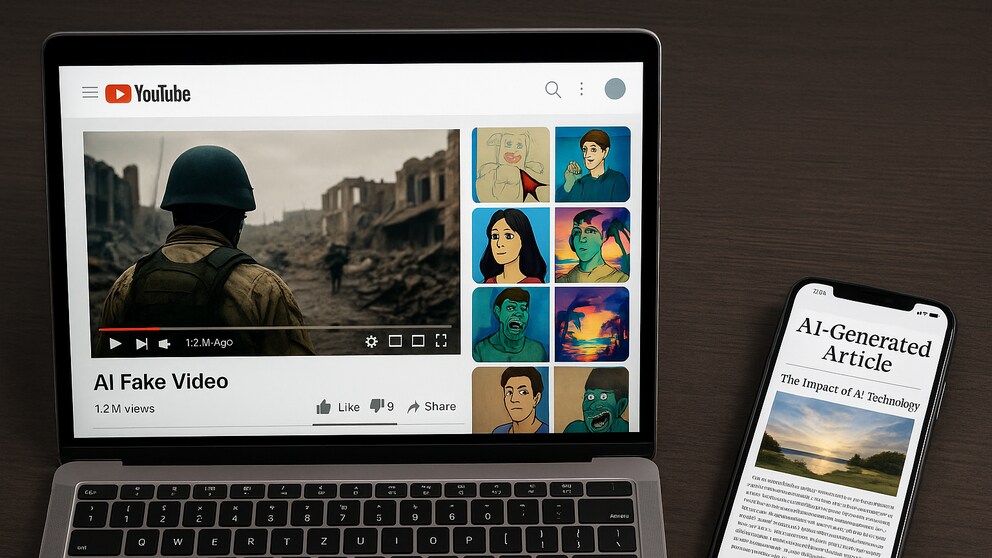
Videos where children’s drawings come to life or people transform into monsters. Photos showing people as comic characters or some fabulous sunsets at the world’s most beautiful beach. Thanks to AI, such fun, emotional, and often nonsensical content is flooding all online platforms. Experts call this phenomenon AI Slop or AI junk. TECHBOOK aims to show in this article why this form of AI-generated content can become a real danger over time.
Some experts refer to AI Slop as the new spam. In the early days of the World Wide Web, unscrupulous businesspeople flooded email inboxes with completely absurd messages. Retrieving daily news became a chore because truly important information was buried in spam.
Overview
Similar things are happening right now on many video, photo, or music platforms and, of course, in social media. AI-generated media is flooding the online world and poisoning algorithms. Once someone clicks on such nonsense, they are served more AI Slop.
What Makes AI Slop Dangerous
In a special edition of his HBO late-night show “Last Week Tonight,” host John Oliver highlights the real AI Slop problem:

Of course, such AI videos or photos can sometimes be genuinely funny. Most people are also aware that these are media created with the help of AI. But extreme nonsense videos are not the problem. It starts when only tiny details are changed that are not immediately noticeable. When the shocking video from a war zone does not document reality but only provides an AI-generated depiction of a reality that serves propaganda purposes.
Trust in photos and videos is being massively shaken by AI. Naturally, a certain basic skepticism in assessing media content has never hurt. But AI blurs the line between reality and falsehood at a rapid pace.
“If those interested in truth, for good reasons, in the future take everything they see and hear on screens with skepticism, but those who are ultimately only interested in entertainment, outrage, and the confirmation of prejudices accept everything that comes their way, then the irrational and outrage-exploiting forces win the discourse,” warns Kevin Baum. He has been researching AI and ethics for years at the German Research Center for Artificial Intelligence (dfki) in Saarbrücken.
Online Platforms Suffer
AI Slop has the potential to further fuel the outrage machine we already know from social media. It’s about nothing less than the authority to interpret what is true and what is false in the world.
AI Slop already operates at a much lower threshold. Many well-known online platforms like YouTube, Pinterest, Spotify, and Wikipedia are now suffering from the mass uploads of AI content.
This happens almost every second thanks to increasingly faster AI models. Just a few clicks to generate 100 new photos with stylish home furnishings or 10 dancefloor hit songs or countless true-crime videos where only the AI commits murder because the stories are entirely fictional. AI Slop has also primarily become a huge business model.
On YouTube, new channels with the most absurd stories keep appearing. The click numbers are in the high five- to six-digit range. The cash register rings for the operators of such offerings. They earn from the ads YouTube places in these nonsense videos.

Myspace Could Suddenly Make a Comeback

Opinion on “Facebook Verified”: “We’ve Given Up”
Algorithms Exacerbate the Problem
YouTube has at least hinted at recognizing the problem recently. Advertisers are especially likely not pleased to find their ads in increasingly nonsensical videos. Therefore, the video portal has now made minor changes to the so-called monetization rules. These determine which videos are compensated through ad placements. In the future, purely AI-generated content will no longer receive money.
Journalists who have been dealing with AI Slop and Deepfakes for some time remain skeptical. “I’ll believe YouTube is really doing something about AI Slop only when it’s truly visible,” says Mats Schönauer, who frequently addresses the topic on his channel.
The nonsensical content of many AI-generated videos is already bad enough. Combined with the workings of algorithms, the problem is exacerbated. The more such media appear and the more frequently they are clicked, the less usable online platforms become. Relevant content sinks in AI Slop.
Increasing “AI Truths” on Wikipedia
This now also affects the online encyclopedia Wikipedia. The popular site is increasingly confronted with pure AI articles full of errors. Therefore, Wikipedia has reacted very quickly by its standards. From now on, obvious AI Slop can be immediately deleted. Anyone familiar with Wikipedia knows that a deletion request usually goes through a time-consuming discussion before anything happens.
The acceleration at which new AI content is created will continue to increase. Every update of the major AI models fuels the pace. Technical solutions alone will not be able to curb AI Slop. Therefore, how AI will change our view of the world also depends on the behavior of each individual. It is up to us whether popular platforms will remain useful or whether AI spam will clutter relevant content in the future.