


April 8, 2024, 3:39 pm | Read time: 5 minutes
Even before the pandemic, many people were familiar with the problem of lacking eye contact in video calls. The software “Casablanca” from “Die Höhle der Löwen” aims to put an end to this.
Nowadays, when people want to communicate without sitting directly across from each other, they turn to technical aids. Especially in the workplace, video meetings have become standard thanks to home office solutions. However, the strange problem of not being able to make direct eye contact persists–either you look directly into the camera or at the screen, but the gazes don’t meet. In yesterday’s season premiere of “Die Höhle der Löwen” (DHDL for short), “Casablanca” was introduced, allowing people to look at each other easily during calls.
Overview
What “Casablanca” from “Die Höhle der Löwen” aims to achieve
“Here’s looking at you, kid,” is arguably one of the most iconic movie quotes of all time. “Casablanca” from “Die Höhle der Löwen” is not named after the classic film for nothing, from which this legendary line originates, and it’s not just a superficial program. “Yes, it’s a great film, and it’s so important to be able to look at each other properly,” explains founder Carsten Kraus in an interview with TECHBOOK. “The film expresses it better than any copywriter we could get.”
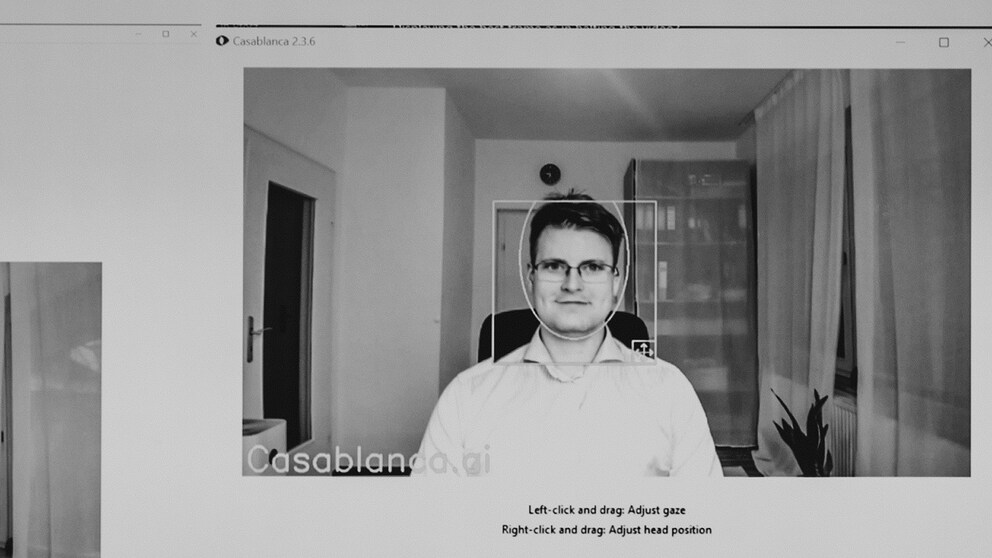
That’s what it’s about: With “Casablanca,” Kraus, co-entrepreneur Markus Vollmer, and their team enable authentic eye contact in video conversations. The interview in Microsoft Teams provides an opportunity for a live demonstration. At the beginning, Kraus and Vollmer look directly into the camera. But only afterward do they reveal that they conveyed this impression with the help of their development. Just a mouse click and the software is turned off, and they look past the camera.
Eye contact is one of the most important forms of nonverbal communication among humans, with several studies conducted in the past. Among other things, it can activate the brain’s reward center or increase the attention of the person being looked at. According to a statement, productivity in teams also increases by 20 percent when people can look each other in the eye at work. These aspects can be lost in video calls: “The lack of eye-level communication is a problem,” says Vollmer. “That’s why we focus on people and especially on the gaze, which for us consists of eyes and face.”
Also interesting: How good is the mobile game “Zeedz” from DHDL?
How “Casablanca” works
Kraus and Vollmer aim to create authentic eye contact. This is achieved by the AI-supported software artificially correcting the camera angle. So if someone is looking down at the screen due to their seating position–which can be perceived as arrogant, even if not intended–a correction is made.
“We don’t want to convey these messages, but only exactly what the person wants to say at that moment. Facial expressions play an incredibly important role,” says Kraus. At the same time, the development doesn’t operate continuously. People are not forced to stare at others with “Casablanca.”
No hiding possible
Because authenticity also means that the other person must see if someone consciously chooses not to look into the camera. “Many think with Casablanca you can do something else and still have the effect of paying attention. ‘Hey, I can keep playing with my phone during a lecture,'” Vollmer explains. “Or I can even not be at my desk, and the other person still feels like I’m there. That’s exactly not the case.”
“If I don’t behave respectfully, the other person sees that too. We show how the person really looks and only correct this focal point that exists on the screen to the camera.” Furthermore, certain camera angles cannot yet be corrected.
Also interesting: Die Höhle der Löwen – What the learning app “Skills4School” can do

How Good Is the Mobile Game “Zeedz” from DHDL?

Maschmeyer: “The 5 Most Common Mistakes Made by Startup Founders”
How secure is “Casablanca”?
“Casablanca” can be used with all common video conferencing systems. The application only works on end devices, such as a laptop or desktop computer. It “works like a webcam, but you install it like software, like a driver. And it has no attack surface externally,” the creators explain.
The development does not run on servers or the cloud. This means the data is processed directly on the user’s device and none of it is transmitted to third parties. “The image data doesn’t go out, which is a privacy advantage.”
What’s next for “Casablanca” from “Die Höhle der Löwen”
“Casablanca” currently exists only as a beta version, which can be tested for free. Kraus, Vollmer, and their team are also working on making the software compatible with older computers. Currently, it runs smoothly on Macs from 2020 and on Pentium computers from 2022.
A commercial version is expected to be released soon, with initial orders and commitments for use already in place. The cost? “The full version is expected to cost seven euros per month,” reveals Kraus. Since the target audience is primarily businesses, they are also considering a “limited version for private use.” This version might shut off after 20 minutes.
Carsten Kraus and Markus Vollmer sought 500,000 euros for five percent of the company shares for “Casablanca” on “Die Höhle der Löwen.” During the show or its recording, Carsten Maschmeyer wanted to invest. However, as reported by “Personalwirtschaft” among others, the deal fell through shortly afterward due to a high company valuation.