

July 23, 2023, 6:58 am | Read time: 9 minutes
Artificial intelligence, design, sustainability, production, technology–Anna Franziska Michel brings these elements together with her company Yoona AI. TECHBOOK spoke with the deep-tech founder about the industry and her personal experiences.
Fashion and technology may not seem like a natural fit at first glance. However, Anna Franziska Michel, CEO and co-founder of Yoona AI, demonstrates that there are indeed many similarities and, above all, synergies. With an AI-based software solution, she aims to shorten production processes in the design sector, making them more modern and sustainable. In an interview, TECHBOOK discussed with her how she envisions the future of the industry, what it’s like to found a tech company as a woman, and why technology and sustainability belong together.
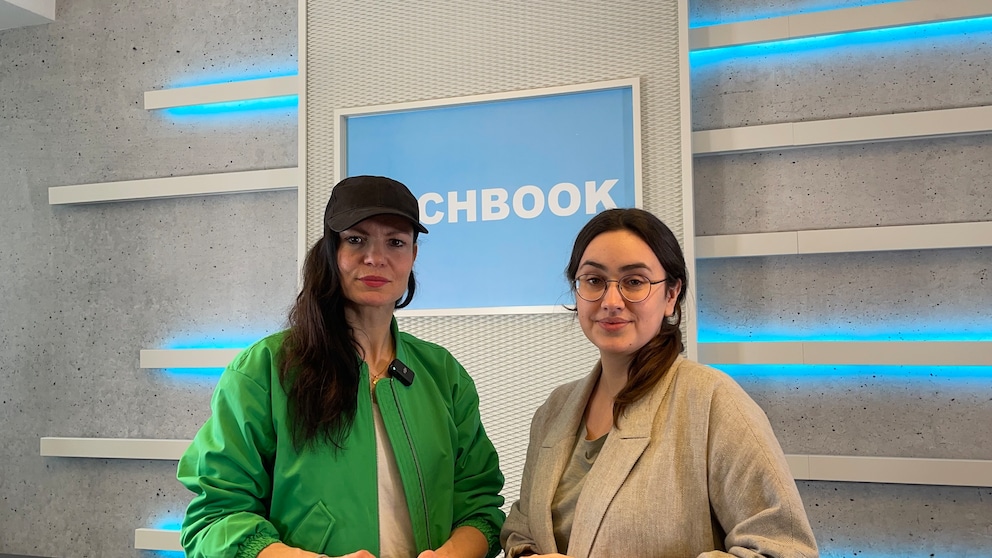
Yoona Founder Anna Franziska Michel in Interview
TECHBOOK: A woman leading a tech company is still unusual. How did you get there?
Anna Franziska Michel: I actually know quite a few others now, and there’s a nice community where you can exchange ideas. Originally, I studied to become a teacher; sports and art. Then I studied fashion design, earned my bachelor’s, developed collections, pursued a master’s, founded a fashion company, worked at other companies, and realized: This is not how I want to work.
As a creative person in such a fashion company, you think you can be creative there. Unfortunately, that’s not the case. And it’s not sustainable either. So I considered what could be done about it. That quickly led to IT. I wanted to learn coding, so I wrote software with a friend. The idea was to make designs more personal so people would wear them longer.
Through that, I returned to my university, started my master’s, ended up in business informatics, and, together with Prof. Dr. Ingo Claßen, founded a research group. We spent two years with other master’s students exploring how AI can be used in the fashion or specifically the creation sector.
Where does your general interest in AI and coding come from? Was there a kind of initial spark?
Primarily, I wanted to shorten processes, and through that, I wondered how everything could become more digital. I did a lot of research, had countless conversations, traveled across Germany, looked at fashion companies, and also exchanged ideas with technology experts.
Then it all grew organically. For example, we had panel discussions on digitization and fashion at Fashion Week as early as 2015. Everything was always focused on how to change the industry sustainably. In hindsight, I can say today that this applies not only to this industry but also to many others.
For example?
For example, the automotive industry, furniture industry, packaging–basically, any area where something is created and then manufactured. So almost everything (laughs).
Processes need to become more efficient; much is still done manually. Especially in terms of digitization, Germany is somewhat behind and not at the top of many rankings. My vision has always been to help the middle class. And they especially need to digitize to move forward and be more sustainable.
What Exactly Does Yoona Do?
Can you briefly explain how Yoona works and functions?
The goal is to digitize the entire product value chain, from the creation process to sales. We are both a product and a research process. We started with a Neural Painter, which “only” drew. Today, generative AI can already create many variations of a design.
Design is always visual. We train the AI, either with inspiration from the internet or with the company’s data. This is how the product evolves. The company also has an augmented reality app with integrated 3D technology to visualize new designs.
In January (2023, editor’s note), we also launched the associated metaverse, a digital space where products can be purchased. For us, it’s also a “learningverse” because it’s entirely new to us. We can find out how to present things in such a space. Theoretically, anything is possible: products in 3D, video boards, and much more. Our goal is to summarize the entire product chain in just a few clicks.
So far, Yoona is primarily a B2B solution for business customers. But it could also be applicable for B2C, regular consumers, if you think a bit further, right?
Theoretically, it’s possible by bringing Yoona to the companies’ websites. This can make things much more illustrative. Theoretically, it can be applied to everything, clothes, accessories, etc.
What does the Yoona team look like at the moment?
We are currently supported by HTW Berlin. We also have an office there, in the start-up center. It’s great because you have other start-ups around you. We are a ten-person team; not everyone is here in Berlin, and much is done remotely. It’s also very important to me to involve women. For example, we have a machine learning expert.
Also interesting: Tech founder in interview: “Many terms from the digital world were a shock for me in applications”
Experiences as a Woman in the Tech Industry
What was your personal journey as a woman to founding a company?
I founded the fashion company relatively early. I was always self-employed and never really employed anywhere. Founding a tech company was something very organic; I grew into it. If I had seen everything at 20 as I do today, I would have done it all at 20. But that brings us to the topic that women are often raised in a certain way, especially regarding entrepreneurship.
Even though it should be normal for a woman to found an LLC, even at 20 and in the technology sector, it isn’t. I wish for girls and women that it becomes a given. By now, there are some really young women who start a tech company in their early 20s. That makes me proud.
Did you have specific role models, especially when you founded the company?
Male ones (laughs).
Which is totally okay (laughs).
Initially, it was the classics. Elon Musk, Bill Gates, the big names. Then you say to yourself, “Let’s do it the same way!” (laughs). But that was mainly at the beginning.
Now I have more start-up founders as role models; there are simply more than before. The Bumble founder, for example, has now gone public. Such people are, of course, role models.
Do you notice that you might be a role model yourself by now?
Actually, yes, when I’m a speaker somewhere. Many young women approach me or write to me. That’s also an important motivation to keep going and to help others overcome certain fears.
I started with two other women back then, who both ultimately chose the secure job. So they didn’t continue on this path. Perhaps this is also something society explicitly passes on to women, where a certain willingness to take risks is lacking. You can see that initially in my own life with the teaching degree.
Also interesting: eSportswoman Dilana: “How often I’ve heard: ‘You’re really good for a woman'”
Sustainability Thanks to AI
The idea of sustainability in the value chain was a major drive for you. Where do you see the greatest potential in this regard in the coming years?
For me, technology and sustainability go hand in hand. For example, if you work with digital A/B testing in product development, you can more precisely determine from the start which product is actually wanted.
This eliminates prototypes that no longer need to be created. You get more accurate design and product ideas and also counteract overproduction. The metaverse is also part of this, where products are offered digitally. For me personally, it would also be a really cool solution: You click on a product, get it three days later, and it still doesn’t have to be pre-produced.
How realistic is that?
That brings us to examples like Shein, which recently faced another backlash. But if you were to implement Shein’s fully automated processes in sustainable companies, much would be possible. My wish would be for everything from the backend to the production site to be automated in the product area. That would be both conceivable and sustainable.
The topic of AI is also quite hotly debated. Recent developments around ChatGPT and others have fueled this further. There’s often a concern that such generative AI destroys creative processes. What’s your take on that?
I studied art before, so I come from a creative field. In my professional life, I then realized that only 20 percent of what was sold was “creative.” The other 80 percent are so-called basics, which don’t have much to do with creativity. This can certainly be transferred from fashion to other areas.
These 80 percent basics can be well represented by AI because it’s essentially data analysis. Personal creativity can then be applied to the remaining 20 percent. Although even there, AI can be used as inspiration. I use ChatGPT, for example, when I’m giving a lecture. Or even in coding, such a program can be a real help.
Where do you see further development opportunities for Yoona?
We are in a good position because we were involved in many developments quite early. The metaverse, which I already mentioned, is a new opportunity. We accompanied the entire Fashion Week with it, and panel discussions with avatars also took place. Such hybrid or purely digital solutions are the future, and in my opinion, we are doing real pioneering work there. And even my children in the next generation see these things very differently than we do.
I was recently in New York and Boston to exchange ideas on 3D printing. I also see an opportunity to produce clothing on demand, meaning first digital product development and then subsequent 3D printing. This is a way to translate the metaverse back into the physical. There are already designers testing this, which is, of course, very exciting for us. Clothing is not an easy case, although material is also a general issue. Plus, everyone needs clothing. That makes the industry one of the largest in the world.
Thank you for the conversation and the fascinating insights.