


July 27, 2026, 5:50 am | Read time: 7 minutes
Over the years, Apple has made quite a few missteps. From Bendgate to “You’re holding it wrong”—TECHBOOK presents the biggest flops.
The company often tries to sweep problems under the rug and rarely admits its own mistakes. As a result, buyers seldom receive an apology. Instead, freebies, discounted repairs, or extended warranties are offered. A journey through the history of Apple’s best and funniest flops.
Overview
AirPower (2019)
The most recent example on our list of major missteps is the Qi charging mat AirPower, announced in 2017, which was supposed to allow iPhone, Apple Watch, and AirPods owners to charge their devices wirelessly. In 2019, Apple had to admit that the project had failed technically.
Batterygate (2017)
At the end of 2017, complaints about deteriorating performance in older iPhone models increased. Geekbench developer John Poole demonstrated in a Reddit post that iOS deliberately slows down performance to preserve battery life. After initial hesitation, Apple confirmed the throttling, explaining it was to prevent sudden shutdowns. However, due to the secrecy, users saw it as a hidden attempt to force them to buy a new device.
Don’t let #BatteryGate get you down. Stop waiting on Apple and replace your iPhone battery yourself!
— iFixit (@iFixit) April 17, 2018
Ultimately, Apple apologized for the incident and added a feature in iOS to disable the throttling. The company also offered iPhone 6 or newer owners a battery replacement at a reduced price of 29 euros until the end of 2018.
Hockey Puck Mouse (1998)
Not much needs to be said about this round mouse—except that it was impossible to use. A classic example of form over function that completely missed the mark. The utterly unergonomic shape of the mouse forced users to cramp their fingers to press the button. At least the colorful iMac G3, with which the mouse was shipped, has now become a cult object. And somehow, the mouse is part of that. But only somehow.

Speaking of mice, the Hockey Puck wasn’t Apple’s only design flop in this area. The best example is the wireless Magic Mouse 2, whose charging port is on the bottom. Charging the mouse and using it at the same time? No chance.
iPhone 6 Bendgate (2014)
The iPhone 6 marked a new era for Apple: From then on, the company offered its smartphones in two sizes. The regular iPhone 6 and the iPhone 6 Plus were both larger than the previous iPhone 5 model, and that’s where the problems began. True to Apple’s style, the devices had to be slimmer despite the larger size, and just a few days after launch, the first complaints emerged. A user posted a photo on the Macrumors forum showing a noticeable bend in his iPhone 6 Plus. Shortly after, YouTube was full of videos of people trying to bend their iPhones by hand. According to Apple, only a few users were affected by the problem, but Apple offered free replacements if the bending occurred through normal use.
On the internet, the bending feature of the iPhone 6 became known as “Bendgate.” Apple gave the subsequent iPhone 6s a thicker aluminum frame to prevent further incidents of this kind. Since the iPhone 6 Bendgate, some reviewers have tested every new smartphone for structural integrity. Among them is Zack Nelson, who runs the YouTube channel JerryRigEverything and subjects smartphones to a torture test to examine their durability.
This test also claimed the new iPad Pro at the end of 2018, which simply folded in the middle under the “two-thumb test.” Some iPad Pro owners complained that their devices were slightly bent. Many were reminded of Bendgate, and the reactions were so numerous that Apple felt compelled to issue a statement in early 2019. The company admitted that some devices might have slight bends, but said it was normal and did not affect functionality.
Apple Maps (2014)
By now, you can hardly tell that Apple’s own mapping service was once one of the company’s most controversial missteps. Introduced with the iPhone 6, Apple Maps was supposed to replace the already excellent Google Maps on iOS. However, it turned into a disaster. Apple Maps was so bad that numerous users were misled by navigation, and in some places, buildings, cities, or entire islands were incorrectly mapped. Moreover, the satellite images were sometimes in black and white or completely flat, instead of the promised 3D.

Apple Maps was one of the rare cases where Apple issued an official apology, which has since disappeared from the Apple site. In the apology, Tim Cook wrote that they had failed with the launch of Apple Maps and would do everything to fix the problems. In the meantime, users were advised to use alternative maps from Google, Waze, or Bing.
iPhone 4 Antennagate (2010)
After two years of slippery plastic backs on the iPhone 3 and iPhone 3GS, Apple introduced the iPhone 4 in 2010 with a glass back and aluminum frame. The admittedly sleek design had a fatal flaw: Shortly after launch, buyers discovered that the signal would suddenly disappear during calls, causing the call to drop. The aluminum frame acted as an antenna array that was simply blocked in certain hand positions.
Apple’s first response to the problem: “You’re holding it wrong.” This phrase went down in internet history and is still often referenced today when a device doesn’t work as it should. A few weeks later, however, Steve Jobs apologized for the fiasco known as “Antennagate” and promised to remedy the situation. You might wonder what the solution was. Apple simply distributed colorful bumper cases that covered the aluminum frame—a practical and inexpensive solution, at least for Apple.
Apple Pippin (1996)
Okay, this is practically an antique, yet the Pippin was one of the biggest flops for the young Apple. The Pippin was developed by the company together with Bandai. It was originally intended to be an affordable Mac for gaming. What resulted was an overpriced game console with internet access and a desktop operating system that sold—believe it or not—only 42,000 units.
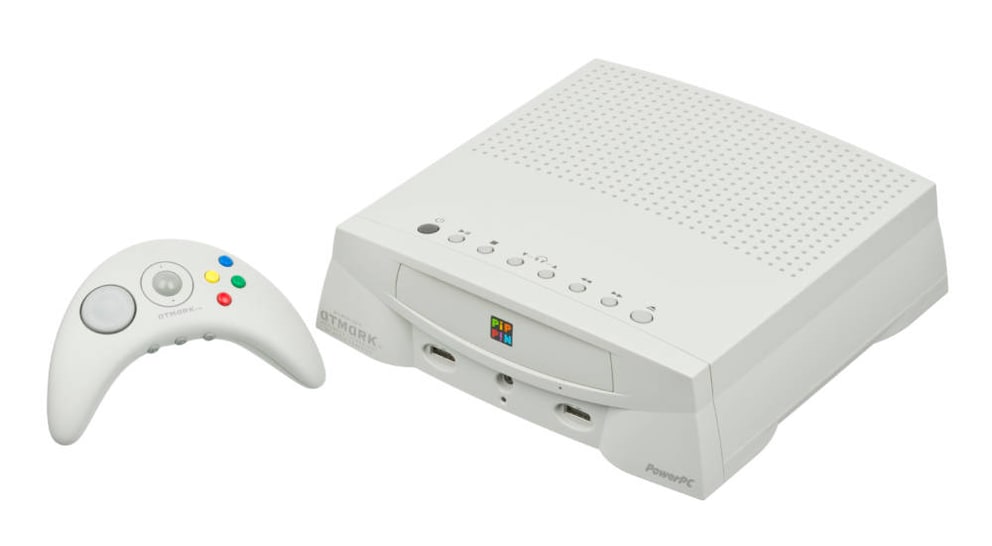
You don’t even have to compare it to the 100 million units sold of the original PlayStation to see that the Pippin was an absolute flop. Fifteen months after its launch, the Pippin was put out of its misery and discontinued—shortly after Steve Jobs returned to Apple.

Tim Cook on His First Really Big Mistake

Apple’s Greatest Successes–and the Most Spectacular Flops in Company History
Power Mac G4 Cube (2000)
In 2000, Apple introduced a new Mac. The special feature: the transparent acrylic case. Otherwise, the cube-shaped computer was a design masterpiece. Unfortunately, Apple seems to have neglected many other aspects—especially performance and price.
The Power Mac G4 Cube was simply too expensive and too underpowered. Another criticism was the lack of expandability due to the absence of PCI slots, which were available in its predecessor, the Power Mac G4. The beautiful case also literally developed cracks. After just a few months, it became clear that the device would be a flop—Apple removed the “designer computer” from the lineup.
Butterfly Keyboard (since 2016)
Although our list mainly contains infamous examples of Apple’s iPhones, there are also plenty of questionable design decisions with the popular MacBooks. Practically every year, new problems come to light; recently, iFixit reported on the Stagelight issue, where MacBooks literally go dark due to too-short connection cables.
A problem that has persisted across all MacBooks since 2016 is the so-called Butterfly Keyboard. Apple proudly introduced it in the 12-inch MacBook of 2016. It has since been installed in all new MacBooks. Compared to the classic scissor keyboard, the Butterfly Keyboard can be much flatter, making the MacBook itself thinner. Aside from the fact that the keyboard can be awkward and uncomfortable to type on, it is also extremely susceptible to dust. Once small dust particles get under the keyboard, the keys can block and no longer register input. Apple has now installed a new version of the keyboard in its current MacBooks, with a silicone layer under the keys. According to Apple, this is supposed to dampen typing noises, but many suspect it is to protect the keyboard from dust intrusion.