


November 23, 2025, 3:18 pm | Read time: 3 minutes
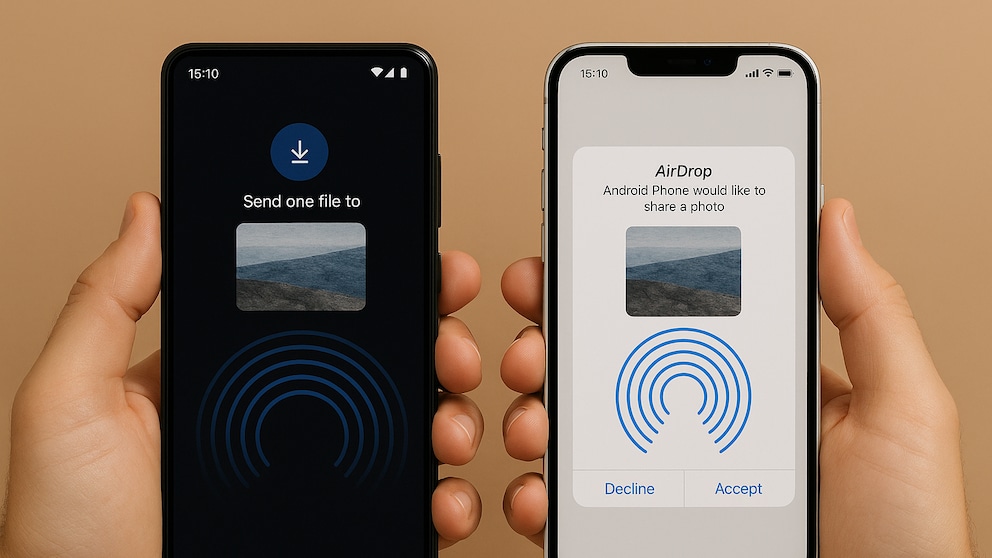
It sounds completely absurd, but it’s true: The two most important mobile operating systems in the world have so far had no way to communicate directly with each other. A major oversight in the cloud era, where everything seems interconnected. But now the barriers are coming down! Google has developed a solution that allows Android and iOS to share files directly without using messengers, cloud links, or USB cables.
Android Users Can Join the AirDrop Cloud
While iPhone users can easily “AirDrop” among themselves, there’s no simple method when an Android smartphone is involved. Then, a messenger like WhatsApp or a cloud transfer is often the only solution. The simple reason: AirDrop is one of Apple’s core technologies designed to incentivize buying an iPhone. Google has long tried to develop a comparable method but struggled to match the simplicity of Apple’s crown jewel. As every Apple user knows, when AirDrop works, it’s almost magical.
Individual smartphone manufacturers have long worked on their own solutions, but none could reach the level of AirDrop. The breakthrough came with Quick Share, a collaboration between Samsung and Google.
Google has now further developed this technology and apparently found a way to reconstruct and integrate Apple’s solution through reverse engineering. According to Bloomberg, Google achieved this “through its own implementation”—without Apple’s support.

AirDrop Now Works with Android Smartphones

Google Expands AirDrop to More Android Devices
Google Plays 4D Chess
Integrating AirDrop compatibility into Quick Share is more than just a PR coup for Google. It’s a strategic decision in favor of users, who no longer have to choose an iPhone to access AirDrop.
For Google, it’s a smart move. Quick Share becomes a universal exchange platform, independent of the manufacturer. And for Apple, there’s subtle pressure to become more open rather than continue to rely on exclusivity.
Let’s hope Apple accepts this step. Before RCS, the company rigorously fended off various attacks on iMessage in the past. In 2023, Beeper developed a solution to enable iMessage communication with Android. Even the manufacturer Nothing jumped on board and announced a cross-platform messaging app. But Apple simply released an iMessage update that blocked this method. For good reason, as it turned out. Beeper was redirecting messages unencrypted to external servers.
This problem seems to be absent with Google’s AirDrop integration. The company assures that no data ends up on any servers. Allegedly, even “independent security experts” have confirmed this.
Interoperability Instead of Silos
The EU has already made it clear with the Digital Markets Act (DMA) that closed ecosystems are a thing of the past. As TECHBOOK has extensively reported, AirDrop is already on the chopping block. Apple must open the technology to third-party companies in the EU over the coming years.
Google is tapping into this, but with a crucial advantage: It opens AirDrop not just in the EU, but for all users. Worldwide. For users, this is more than just a convenience upgrade. It’s about digital self-determination. Technologies like AirDrop shouldn’t fail at brand boundaries. Google’s initiative shows that open standards can also emerge in competition—when the pressure from users and regulators is strong enough.
In the end, we all benefit: less frustration, more freedom—and perhaps a small step toward a truly connected, cross-manufacturer future.