


November 20, 2023, 4:28 pm | Read time: 4 minutes
Foldables, or foldable smartphones, have been around for several years. The selection of devices has grown significantly. But what types of foldable smartphones are there, and who are they suitable for? TECHBOOK provides an overview.
A lot of display space in a compact format–that could describe the basic idea of foldable smartphones. Manufacturers spent many years refining this concept, and with the advent of the first flexible OLED panels, it became a reality. After numerous concepts, the first commercial foldable smartphone hit the market in 2018. Surprisingly, it wasn’t from Samsung or Huawei, but from the Chinese manufacturer Royole. Its name: Flexpai. However, the device remained a niche product.
2019 Was the Year of Foldable Smartphones
The Galaxy Fold from Samsung, introduced in spring 2019, was far more successful, with a hefty price tag of 2,100 euros in Germany. Folded like a book, it was compact but offered a display size of 7.1 inches when unfolded. However, a weakness quickly became apparent: the folding mechanism. The display was also not as robust as desired.
Huawei also launched its first foldable in 2019 after several delays, providing direct competition to Samsung’s Galaxy Fold. A small hitch: the model was never officially available in Germany. Only its successor, the Mate Xs, made it to our stores in 2020. Curiously, the display was on the outside when folded, making it difficult to use a case.
Manufacturers have stuck to the concept of these first commercial foldable smartphones to this day. Due to the embargo, only Samsung plays a role in the European market now. There are now several generations of the Galaxy Fold. They all open like a book and differ from the flip smartphones available since 2020, which are more reminiscent of a flip phone.
Differences Between Fold and Flip
All current foldable smartphones can be categorized into the fold and flip principles. Samsung offers both types. Motorola exclusively uses the flip principle–inspired by the iconic Razr phone. Huawei, on the other hand, uses the fold principle, as do Honor, Oppo, and now Google.
The flip concept has the advantage of allowing a smartphone to fold incredibly compactly. These flip smartphones offer–aside from a potentially built-in external display–little more display space than a regular device. However, the operation is unique, as flip smartphones also work when partially opened. For example, a document can be displayed in the upper part while the keyboard is shown in the lower part for editing. Or the smartphone can be securely placed on a table without an additional tripod to take photos or make hands-free video calls. Flip smartphones are also the more affordable entry into the world of foldables.
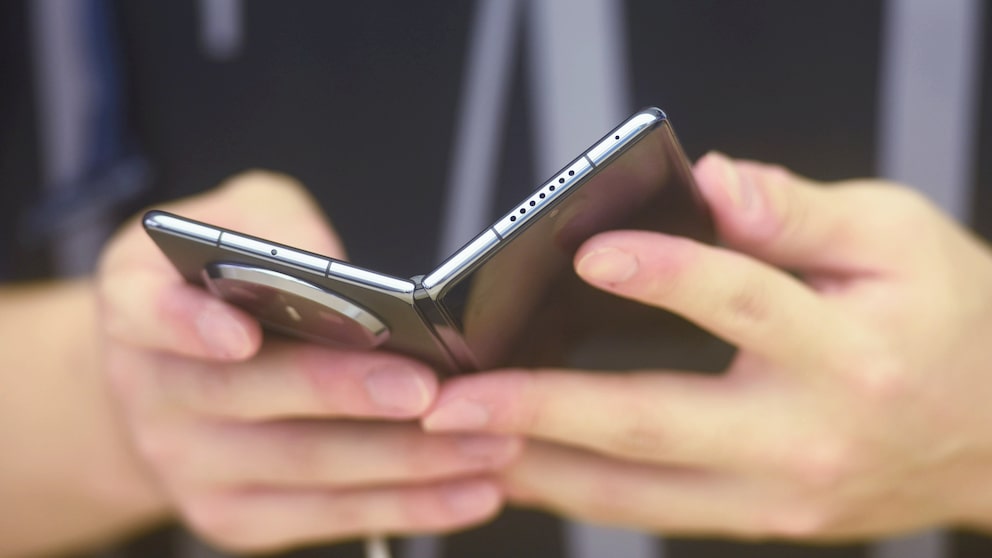
It’s different with the fold principle. These devices are usually significantly more expensive but often offer better hardware with more powerful cameras and more battery life. When folded, the models appear almost like a regular smartphone. When unfolded, they have a display size between 7 and 8 inches, reminiscent of a tablet. Manufacturers had to adjust the apps accordingly to display correctly on such a large screen. Fold smartphones can also be used with one half of the display for viewing and the other as a keyboard or gamepad when gaming.

Lenovo Presents ThinkBook Flip — a Laptop with a fFolding Display

iPhone Fold: When Will Apple’s Foldable Smartphone Arrive?
Key Point: Display
Whether fold or flip–all manufacturers use flexible OLED panels for their devices. These do not have a glass surface but one made of plastic. Only then can the smartphones be folded. Screen protectors cannot be applied, making the displays of foldable smartphones more sensitive than those of traditional devices.
Manufacturers still strive for durability and test the longevity of their foldables in the lab, for example. Current models withstand about 200,000 folding cycles. They can, in principle, be used for many years without damage. However, the panels are never as smooth as those on a regular smartphone; a small curve at the fold is always visible. Additionally, foldable smartphones are never completely sealed. This allows small particles to enter the housing and become quickly visible under the thin panels.
Pros and Cons of Foldable Smartphones
In principle, the main pros and cons can be summarized as follows:
Pros:
- Large display in a compact format
- New operating possibilities, such as one half display, other half keyboard
- Front camera becomes unnecessary due to folding mechanism
Cons:
- Apps must be adapted to variable size changes
- Hinges and flexible OLED make the devices more sensitive than conventional smartphones
- No screen protectors can be used
- Comparatively expensive
Anyone looking to purchase a foldable smartphone should pay attention to these points. However, you also get a device that not only looks impressive but also offers a lot technically–especially a lot of display space in a comparatively compact housing.