


August 16, 2019, 3:39 pm | Read time: 4 minutes
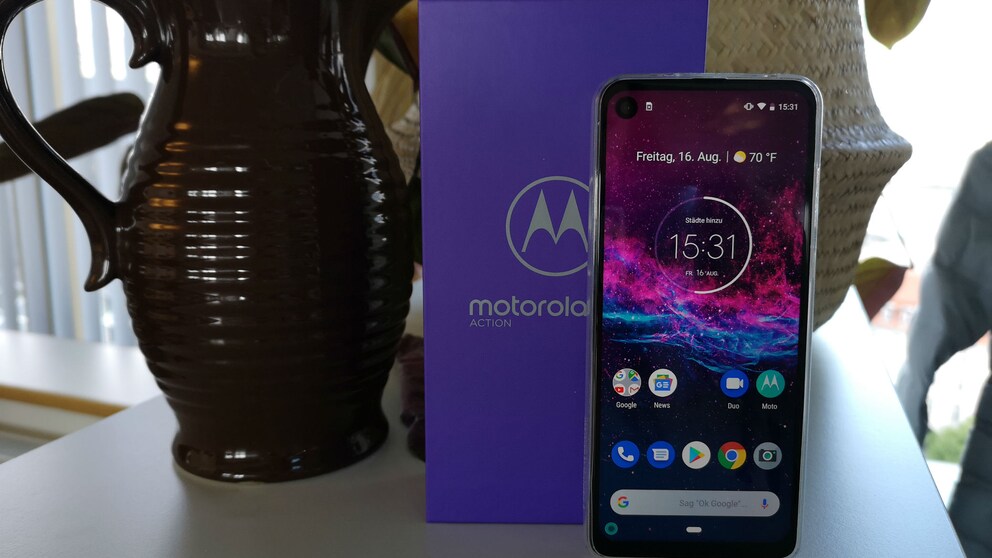
The Motorola One Action is the latest smartphone from Motorola. It is modeled after the One Vision but offers a unique feature alongside its lower price: a triple camera with an action-cam mode.
Motorola didn’t choose the name “Action” without reason. The manufacturer equipped the smartphone with a triple camera that can be used like an action cam. The trick: The Motorola One Action records videos in landscape format while the smartphone is held vertically. This allows for wide-angle video recording even in the conventional smartphone position. TECHBOOK took a closer look at it.
Read more: The Motorola One Vision proves to be a photo marvel in tests
Features of the Motorola One Action
Let’s first look at the technical details of the One Action. The smartphone is based on the One Vision from the spring but comes with a slightly reduced camera setup. However, the Motorola One Action starts at just 259.99 euros–40 euros less than the One Vision. Instead of a 15-watt power adapter, the manufacturer provides a 10-watt adapter. A headset is not included, but the package does contain a silicone case to protect the smartphone. Additionally, the smartphone’s casing is IP52 rated for dust and splash resistance.
A highlight of the Motorola One Action is the full-view display with a hole-punch notch. Motorola calls it Cinema Vision due to its 21:9 format. On the back, there’s a triple camera with a dedicated action-cam mode and a fingerprint sensor for system security. The smartphone runs Android One based on Android 9 Pie out of the box, ensuring two years of firmware updates and three years of security updates.
Powering the device is a processor from Samsung, specifically the Exynos 9609. It’s a mid-range chip with eight cores and a maximum clock speed of 2.2 GHz. It comes with 4 GB of RAM and 128 GB of expandable storage. The battery has a capacity of 3,500 mAh and supports fast charging.
Technical Data at a Glance
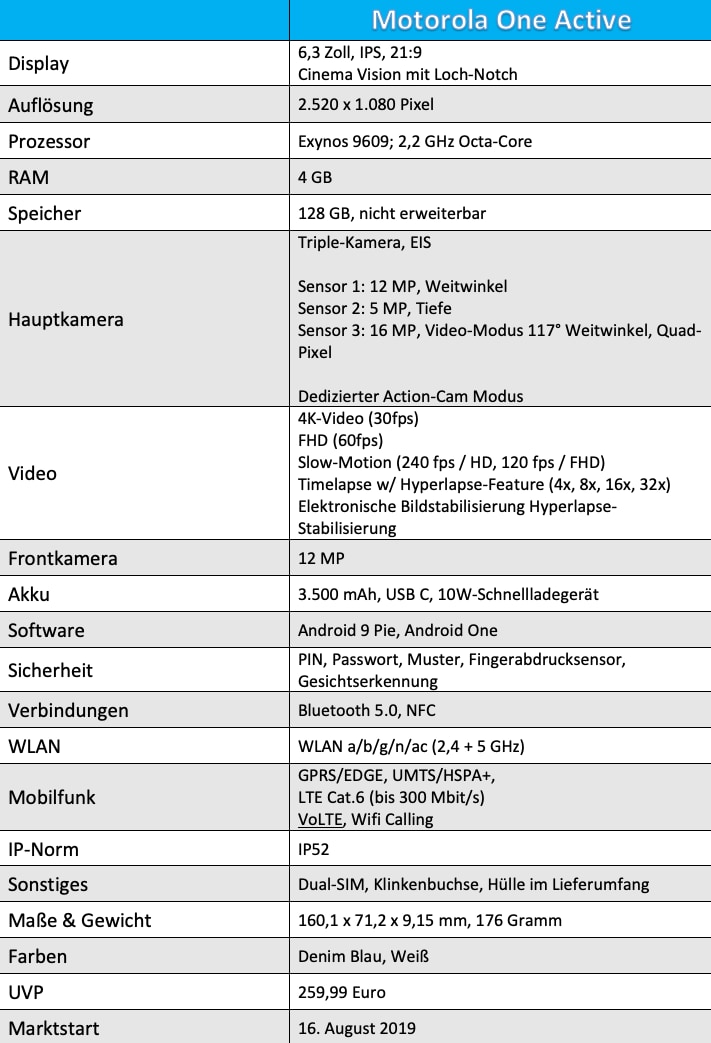
Photo: TECHBOOK
How the Action Cam Performs
The Motorola One Action features a front camera with 12 megapixels and a triple camera with a 12-megapixel main sensor, a 5-megapixel depth sensor, and a 16-megapixel wide-angle sensor. Stabilization is electronic, and the camera records videos with up to a 117-degree wide angle. Such wide-angle lenses are not very common in the under-300-euro price range. Videos can be recorded in 4K at a maximum of 30 fps (frames per second) and in Full HD at up to 60 fps.
In regular mode, the camera records videos as usual. This means if the smartphone is held vertically, the video is also in portrait format. However, in action-cam mode, which users can access via the landscape icon in the camera app, the recording format is reversed. If users hold the Motorola One Action as usual, the camera still records a video in wide-angle format. Conversely, it records a portrait video if the device is held horizontally. Photos can only be taken in action-cam mode if video recording is also running.
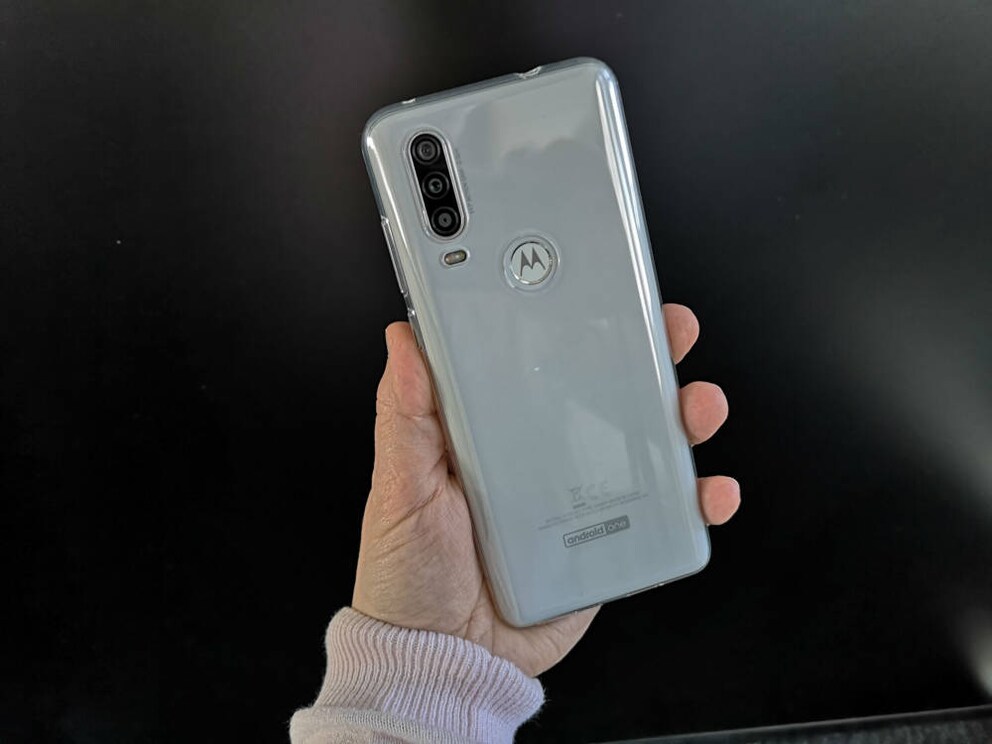
Photo: TECHBOOK
Video Quality Reduced in Action-Cam Mode
To achieve the format change during video recording, Motorola uses a software trick. In the background, the films are recorded as usual, but software simultaneously crops them. This means that a part of the image is essentially cut off at the top and bottom. This wouldn’t be too dramatic if the videos didn’t lose quality in the process. TECHBOOK tried it out and noticed the following: When we recorded a video in 4K, the clip was automatically compressed to Full HD. Full HD films, however, are recorded in the set format. In short, this means that users can only record true 4K films at 30 fps in normal camera mode, not in action-cam mode.
The results with the action cam are quite good but ultimately not entirely convincing. The EIS doesn’t completely stabilize movements. Even when simply walking, slight shakes are still visible, resulting in a slightly blurry impression. An OIS would certainly have been more helpful here, especially since action shots can sometimes be more turbulent.
Additionally, the recording sometimes appears a bit pixelated, even though it was done in a well-lit indoor environment. However, the colors are reproduced naturally, and the camera handles transitions from bright to dark areas well. It remains to be seen how the camera will perform outdoors and with faster movements. We will test that later.