

May 1, 2025, 2:36 pm | Read time: 4 minutes
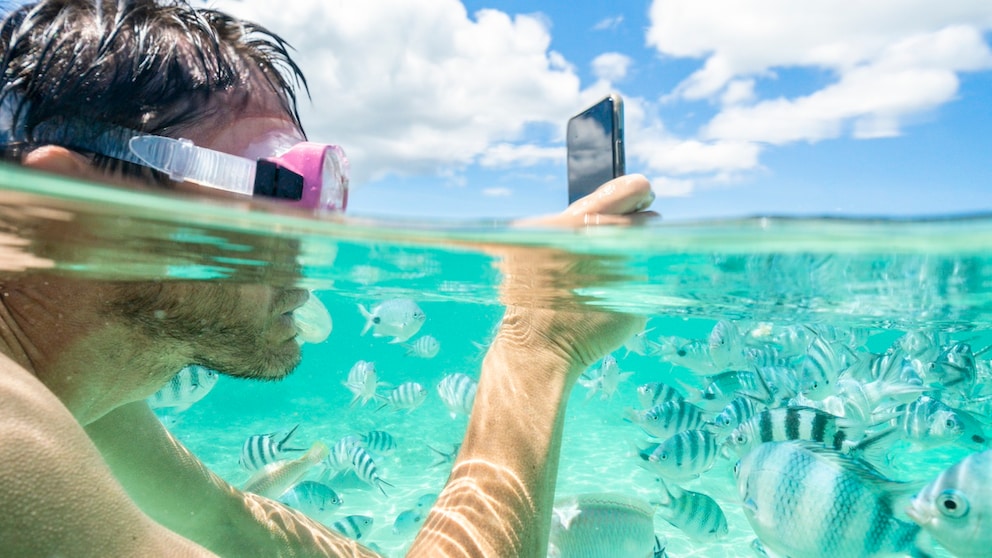
Whether it’s colorful schools of fish, impressive corals, or simply a diving selfie–underwater photography with a smartphone is becoming increasingly popular. However, seawater and pressure present challenges for the handy technology. TECHBOOK offers tips on how to take successful photos underwater.
Many people are drawn to the sea during their vacation, whether at local shores or far away in exotic locations. Those who want to capture their experiences photographically usually do so with a smartphone. While it’s no problem at the beach, it’s a real challenge in the water. How can you take good photos underwater? And how do you protect your device accordingly?
Consider Lighting Conditions for Underwater Photos
Anyone who has tried taking photos underwater knows how challenging it can be. The lighting conditions are different, and the overall composition is extremely important, as is the adjustment of details like ISO and white balance. It’s advisable to familiarize yourself with the details of your smartphone’s camera app beforehand. Where are the settings hidden, and what is possible?
It’s best to photograph toward the sun, which is naturally diffused by the water. This way, you make the most of the natural light. However, you must consider particles floating in the water, which are most visible against the light–but can also be a beautiful part of an underwater image.
Also interesting: What to do if your smartphone falls into the water?
If necessary, you can also use additional equipment like an external flash. Water absorbs light, and colors appear washed out in photos as a result. Additional lighting can better highlight the muted colors.

How to Take Cool Underwater Photos

Three smartwatches stand out, according to Stiftung Warentest
Perspective and Overall Composition
For example, Stiftung Warentest recommends that photographers place the smartphone very close to the subject for underwater shots. It’s best to avoid ultra-wide-angle settings. An external macro lens may even be advisable to capture more details.
Additionally, autofocus can be more of a hindrance in this context. It’s recommended to turn it off beforehand and focus manually instead. Photograph interesting objects from as many perspectives as possible and take your time. However, always adhere to local regulations and avoid potential hazards. Try not to disturb wildlife and avoid environmental pollution and damage when taking photos underwater.
It’s also important to experiment as much as possible–especially if you’re not an experienced underwater photographer. Images look different in this scenario than what you’re used to with typical photos. You can also use scenarios like just below the water’s surface, which incorporate the view outside the water.
The Best Waterproof Cases for Underwater Photos
Many current smartphones advertise a certain level of water protection, such as through IP certifications. But if you want to take photos in the sea, it’s best to play it safe. Seawater is aggressive due to its salt content, and the water pressure while diving poses a risk even for water-resistant devices.
A special underwater housing not only protects against water ingress but also ensures that camera quality doesn’t suffer. Stiftung Warentest tested seven hard and two soft smartphone underwater housings. Only three models received a “good” rating–one case particularly impressed in all areas.
Also interesting: What do IP67 and IP68 mean for waterproof smartphones?
Significant Price Differences
In the July issue of the magazine “test” (07/2024), seven hard cases for smartphones were examined. The price range was from 40 to a whopping 645 euros. The verdict was varied: Three products were rated “good,” three others were deemed “satisfactory.” One case only achieved a “sufficient” rating.
Additionally, Stiftung Warentest examined two inexpensive soft protective cases. These cost under 20 euros–but failed to impress. The verdict: “poor.” The testers concluded that these models are only suitable for protection against splashes and sand. Those who want “sharp, high-quality photos should spend more money.”
Test Winner Impresses with Best Handling
The clear number one in the test was the underwater housing from Sealife (Sportdiver Smartphone Housing SL400-U). For 290 euros, users received not only excellent image quality but also superb handling. The overall rating: 1.8–the best score in the test.
In second place was the housing from Divevolk (Seatouch 4 Max), available for around 250 euros. It achieved an overall score of 2.3. The model from Kraken (Universal Housing KRH08 V2) for 460 euros followed closely behind with a rating of 2.4.
With material from dpa.