


December 17, 2025, 2:01 pm | Read time: 3 minutes
The ongoing memory crisis is expanding its reach. Several manufacturers have already raised the prices of their devices because the costs for memory (DRAM) have risen sharply. Market researchers now expect a contraction in the smartphone market due to higher production costs. Low-cost devices are particularly affected, as profit margins are especially small here. Additionally, customers should brace for higher prices.
Global Decline in Smartphone Sales
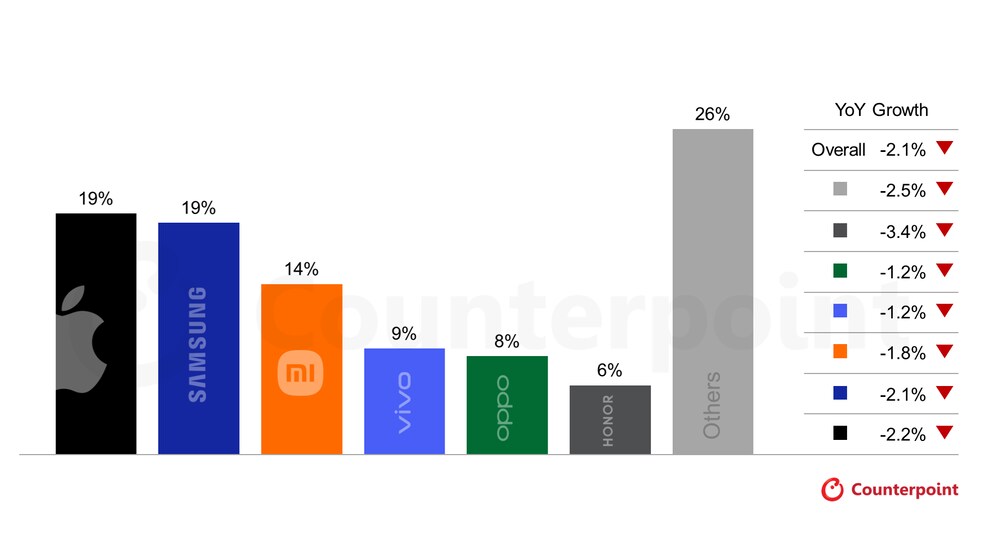
Analysts from Counterpoint Research predict a 2.1 percent decrease in sales for 2026 compared to the previous year. They have revised their forecast downward by 2.6 percentage points. The adjustments are particularly significant for Chinese manufacturers like Honor, Oppo, and Vivo. Smartphones in the lower price segment are most affected due to high price sensitivity.
Rising prices for DRAM chips are already having noticeable effects on the bill of materials (BoM). Lower-cost devices are particularly affected, but the high-end segment is also feeling the impact. Research Director MS Hwang stated: “What we are seeing now is that the lower market segment (under $200) is most affected, with BoM costs having risen by 20 to 30 percent since the beginning of the year.”
In the mid-range segment, BoM costs have increased by about 15 percent, and for high-end devices, by about 10 percent. Further cost increases of between 10 and 15 percent are likely by the second quarter of 2026.
Higher Smartphone Prices and Hardware Downgrades
According to the analysis, memory prices could rise by another 40 percent by mid-2026. Many manufacturers cannot fully pass these price increases on to customers. Senior Analyst Yang Wang notes that “significant price increases for smartphones are not sustainable” in the low-cost entry-level segment. If manufacturers cannot pass on the costs, the product range begins to thin out.
As a result of these developments, average selling prices are expected to rise significantly. For 2026, Counterpoint anticipates an increase of 6.9 percent, up from the September forecast of 3.9 percent. Manufacturers with a large production base, broad portfolio, and high manufacturing depth are better equipped. “Apple and Samsung are best prepared for the coming quarters,” Wang said.
Also of interest: These 7 Old Phones Are Worth a Small Fortune Today
Other providers are responding with technical adjustments. Senior Analyst Shenghao Bai reports: “In some models, we are seeing downgrades of components such as camera modules and periscope solutions, displays, audio components, and, of course, memory configurations.” Additionally, older components are being reused, the portfolio is being streamlined, and higher-quality variants are being emphasized.