


March 13, 2026, 3:19 pm | Read time: 3 minutes
Google continually improves its map service with minor tweaks. However, fundamental changes to design and functionality are rare. Now, Google Maps is getting a major update with two key innovations that will completely change how users interact with the app. These updates aim to help users find places and navigate more intuitively.
Immersive Navigation in 3D
Google calls it the “biggest navigation upgrade in more than a decade.” The company has fundamentally revamped not only the display but also the route guidance itself.
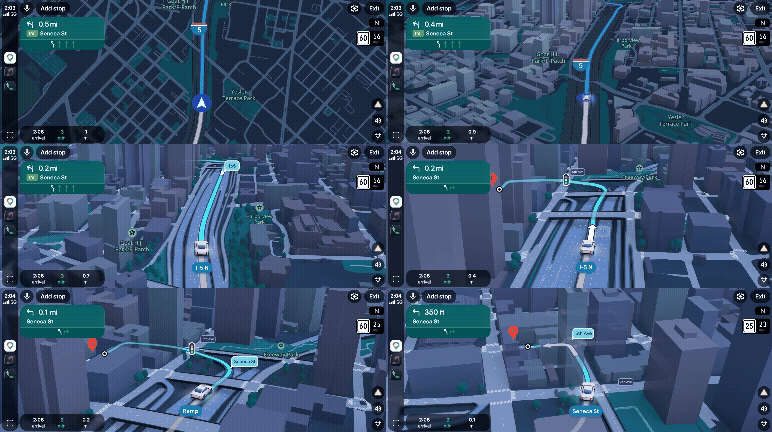
At first glance, the standout feature is the 3D view with detailed buildings, bridges, and terrain, reminiscent of Apple Maps. Like its rival, Google Maps now also shows lanes, crosswalks, traffic lights, and stop signs. Even medians and landmarks are included to aid orientation in Maps.
The key innovation is the intelligent highlighting of these details to help users make the right turns. This is based on current Street View and aerial images analyzed by Gemini models.
More Overview and Real-Time Guidance
The map will now show larger sections of the route in advance and rotate and zoom the image so users always have the best view of turns, lane changes, or exits. To ensure 3D buildings don’t obstruct the view, they will automatically become transparent. Spoken directions are now more natural–Google compares this to a friend helping with navigation.
Additionally, Maps now informs users about possible trade-offs for alternative routes–such as longer travel time with less traffic or faster routes with tolls. According to the company, over five million traffic updates are processed per second.
Before starting a trip, users can check the destination with Street View. Upon arrival, Maps marks entrances, parking options, and the correct side of the street. “Immersive Navigation” launches in the U.S. and will gradually roll out over the next few months for compatible iOS and Android devices, CarPlay, Android Auto, and cars with Google built-in.
“Ask Maps” for Complex Queries
AI chatbots are now ubiquitous. Their big advantage: They can understand and answer questions in natural language. With “Ask Maps,” Google is introducing this feature to Google Maps. Users can ask questions like “Where can I quickly charge my smartphone?” or “Which tennis court is lit in the evening?” The answers appear directly with the appropriate map view.
The feature accesses information contributed by users themselves. Maps also considers previous searches and saved places to tailor results individually.
Also interesting: Google Maps reverses controversial change
Travel plans can also be structured this way. By roughly specifying desired destinations, Maps creates suitable routes and can show interesting places along the way contributed by other users.
Found locations can be directly reserved, saved, or shared. Navigation can then be started with just a few steps. “Ask Maps” launches in the U.S. and India for Android and iOS, with a desktop version to follow.