

April 25, 2018, 3:16 pm | Read time: 8 minutes
Manufacturers of so-called anti-aging devices promise to tighten skin and eliminate wrinkles. But can the face really become smooth that easily? TECHBOOK tested the FaceTite for five weeks.
I, the TECHBOOK editor, wanted to find out what these devices can really do and tested one for five weeks. Admittedly, at 28, I don’t have deep wrinkles on my face, but a few lines are already visible—at least I haven’t been asked for my ID when buying alcoholic drinks for a long time. Besides, they always say: Prevention is better than cure. Maybe the device can even prevent me from getting wrinkles at all.
The Device
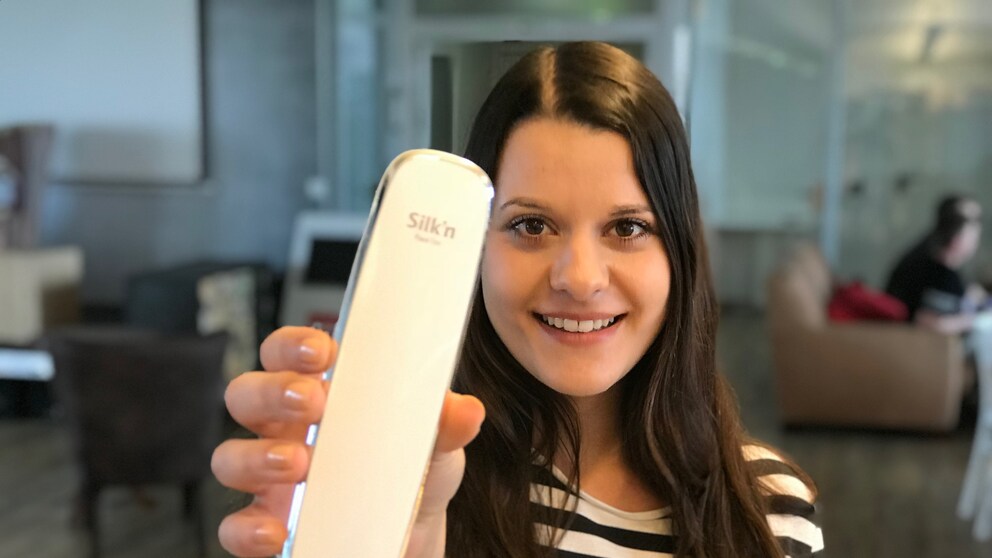
Online, I find a variety of anti-aging devices. I choose FaceTite from Silk’n. “Tighter skin without surgery,” promises the product. Three different energy sources are supposed to ensure this: bipolar radiofrequency, LED light energy, and infrared light. Twice a week for 15 minutes should be enough to see initial results after five weeks. “This process improves skin tension, makes the skin firmer and more elastic. Wrinkles and fine lines recede, and facial contours are visibly lifted. Sun and age spots on the skin surface decrease, and the structure and elasticity of the skin are improved,” writes the manufacturer.
All this is available for 199 euros, placing the device in the mid-price range. It’s not really cheap, but if it works, I might save myself several visits to a beautician or even a surgical procedure. The FaceTite comes with a slider gel and a hyaluronic serum.
The Test
Before testing the device, my face is examined by dermatologist Dr. Yael Adler. The dermatologist has written several books, including the bestseller “Haut nah: Alles über unser größtes Organ” (“Skin Deep: Everything About Our Largest Organ”). “You don’t have any wrinkles yet,” says the doctor as she examines my face. I feel flattered, but I am aware of my delicate lines. The dermatologist explains the structure of the skin and the fact that wrinkles can only be fought if a device reaches the deepest skin layer, the dermis. Dr. Adler recommends using the anti-aging device only on one side of the face to achieve a better effect. I choose the right side.
With a measuring device from Courage + Khazaka electronic GmbH, the only manufacturer of such a device, I measured the changes in my skin before, during, and after treatment with the FaceTite. The device can measure moisture and elasticity values. These are crucial for the formation of wrinkles. I measure the areas of the forehead, eyes, and cheeks, each three times, and calculate an average to achieve the most accurate result possible.

The Application
Before my first application, I measure the values for elasticity and moisture. Then it begins. First, I use the very liquid hyaluronic serum and apply it to the right side of my face. Then I apply the included slider gel, which feels very slimy and reminds me of ultrasound gel. Now I move the FaceTite over my face on the first heat level and increase it every three minutes until I reach the highest (five). Overall, it feels a bit like ironing my face due to the heat.
The device warms the skin pleasantly, but at level five, it becomes too hot for me, so the highest application level is now off-limits. After 15 minutes, the procedure is complete. The look in the mirror surprises me: My right face actually looks plumped and better blood-circulated, small wrinkles seem smoothed out. However, I also notice something else in the mirror: The gel didn’t stay on my skin and ended up in my hair—a rather slimy affair! Washing hair afterward is a must.
As impressive as the first use of the FaceTite is, the result is sobering the next morning. My face looks completely normal again. Manufacturer Silk’n promises visible results only after five weeks, so I must not be impatient. From now on, I use the device at least twice a week for 15 minutes each. Every time I feel like I see an improvement directly, but it seems to fade by the next day. Also, in the moisture and elasticity measurements, no significant changes are noticeable at first glance. Therefore, I now measure directly after the application—and indeed, it’s not just a feeling, but also verifiable: The values for elasticity and moisture are up to 20 points better than before the application.
To perhaps see a greater visible success, I give the test device to my 51-year-old mom. For her, the anti-aging device feels like a spa treatment, but level five is also too high for her. Her skin also looks significantly plumped, and the face is pleasantly reddened. But the next day, this effect is gone for her as well.
In my last test week, I intensify the use once more, using the device daily. Maybe this will make a difference.
Also interesting: How to get more followers on Instagram
The Result
After five weeks, the following values emerged:

Photo: TECHBOOK
The device was not used on the left side of my face, yet the values changed there.

Photo: TECHBOOK
I send dermatologist Dr. Yael Adler the measurement results. “In the average, no significant value has been established on the right side of your face,” says Dr. Adler. Although my moisture values have improved, there are also enormous fluctuations on the left comparison side. The elasticity values behave similarly. “These fluctuations can vary due to sleep side, climate, sweating, skin care, and hormone cycle. At the eye, it has even gotten worse. For me, no wow result,” explains Dr. Adler.
But how is it that my face looks not only less wrinkled immediately after the application but is also measurable? “That you found it subjectively better can be due to the plumping effects of the cream, which only last a few hours at most,” says Dr. Adler. Through the applied heat, the active ingredients of the hyaluronic serum could be better incorporated into the skin.

What to Do if Your Smartphone Falls in Water

Back at IFA after 20 years! It made me happy and sad at the same time
Conclusion: Can Anti-Aging Devices Reduce Wrinkles?
“Every device must be able to overcome the top skin layer, the epidermis, and have an effect in the dermis,” says Dr. Adler. It is crucial that the epidermis (the top skin layer) and the dermis (the deepest skin layer) do not suffer heat damage. Therefore, home devices always have natural limits because they must not have side effects. But what has no side effects often cannot have an effect: “The heat must penetrate deeply, and that is only possible, in my experience, with strong devices like large lasers with high energy and effective cooling. Or a pulse so short that it cannot cause a scar or terrible charring,” reports the dermatologist. “I believe no home device will be able to achieve sustainable wrinkle reduction.”
However, if it is enough for someone to have a few fewer wrinkles for at least a few hours, such heat-based devices in combination with hyaluronic can be helpful. The hyaluronic can be incorporated into the epidermis through the heat, making the face look plumper and juicier for a few hours.
Whether the device actually has a long-term effect on my skin, I will only see in four to six months. That’s how long it takes for the skin to renew and changes to become visible.
What Really Helps Against Wrinkles?
Wrinkles form in the lower skin layers. That’s why it’s so difficult to combat them. “Wrinkles that are already present cannot simply be creamed away,” explains Dr. Yael Adler. Creams only penetrate the first skin layer and remain on it. The ingredients do not manage to penetrate deeper skin layers. The best protection against wrinkles is still a cream: sunscreen. “Sun damage is the main cause of wrinkles,” explains Dr. Adler. In addition, a healthy lifestyle with the right diet, little alcohol, little stress, no smoking, and exercise is important for youthful and beautiful skin.