

October 11, 2024, 4:17 pm | Read time: 5 minutes
The world’s first mass-produced tape recorder, or Magnetophon as the electric sound recording machine was initially called, came from the Allgemeine Elektricitäts-Gesellschaft, or AEG, in 1935. For nearly 40 years, the tape recorder was the undisputed tool of choice for recording sounds, music, and speech.
Strictly speaking, the history of electric sound recording began even earlier, in the late 19th century. At that time, the American inventor and entrepreneur Thomas Edison introduced the phonograph, a device for recording and playing back sound using sound cylinders. Building on this, the Danish physicist and inventor Valdemar Poulsen developed the world’s first functional device for recording and playing back sound waves via electromagnetic induction.
Poulsen initially wanted to market his invention under the name Telephonograph—a coined word from telephone and phonograph. However, since this name was already taken by a French colleague, he eventually named his invention the Telegraphon.
AEG Introduces the World’s First Tape Recorder in 1935
What is still understood today as a tape recorder—an electric recording and playback device for analog sound recording on a plastic tape coated with iron or chromium oxide—came into existence in 1935.
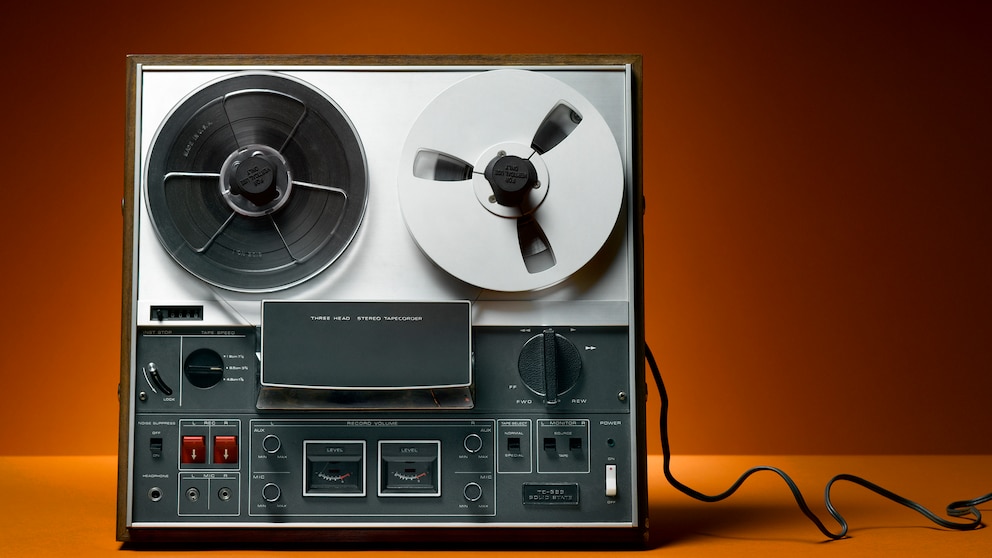
At the 12th Great German Radio Exhibition in Berlin, the German electronics company AEG presented the world’s first tape machine to the public with the model K1. Two reels, the supply reel on the left, the take-up reel on the right, and two tape heads in the middle below—this was the blueprint for all tape recorders that would hit the market in the following decades. The website “Das Tonbandmuseum” (tonbandmuseum.info), which traces the development history of the tape recorder in detail, considers the AEG Magnetophon K1 to be “by far the most outstanding, important technical audio development of the past century.”
Initially, the new possibilities that the K1 and its successors brought were reserved for broadcasting and thus the professional sector. It was perhaps inevitable that during World War II, the Nazis made use of the new technology. However, when “the German economic miracle” took off in the mid-1950s, the situation changed.
German manufacturers such as AEG, Braun, Dual, Grundig, Körting, Loewe Opta, Metz, Nordmende, and Saba quickly realized that good money could now also be made in the home sector. The constantly evolving machines (such as stereo recording and/or different tape speeds for longer playtimes), which could also be operated by private users, triggered a veritable tape recorder boom. This would last until the early 1970s.
Read also: Why the Music Cassette is Making a Small Comeback

Well-Known TV Manufacturer Halts Production

The Historical Failure of Betamax and Video 2000
By the Early 1970s, It Was in Every Third German Household
As early as 1965, Grundig, Philips, and Telefunken unanimously reported that no other manufacturing sector showed such strong growth as the tape recorder segment. This was written by Friedrich Engel, Gerhard Kuper, Frank Bell, and Wulf Münzner in “Zeitschichten: Magnetbandtechnik als Kulturträger Erfinder-Biografien und Erfindungen.” By then, Japanese manufacturers such as Akai, Pioneer, and Technics, as well as Swiss providers Nagra and Revox, had entered the battle for market share. And “Test – the magazine for the consumer,” as the still-existing magazine by Stiftung Warentest was called at the time, reported in 1973 during a comparison test of tape machines that such a device was found in every third German household.
A certain special status was held by the devices of the Swiss entrepreneur Willi Studer and the Hungarian Edmond Uher. Studer had been producing tape recorders since 1948, and Uher had already founded his company Uher and Co. in Munich in 1934. Both companies quickly earned a good reputation as specialist manufacturers of high-quality tape recorders. Their brand names, Revox and Uher, were even used as synonyms for tape recorders per se.
But at the height of tape recorder enthusiasm in the early 1970s, the decline was already looming. The new cassette recorder for compact cassettes replaced the tape recorder as the tool of choice for sound recordings. It took up less space, was easier to use, and was not least significantly cheaper than a tape recorder.
Especially with the introduction of the radio(cassette) recorder, a recorder with a radio part in the same housing, manufacturers hit the nerve of the youth from the mid-1970s. Pop songs could now be recorded directly from the radio onto cassette, allowing people to compile their own hit lists. Additionally, the corresponding work of a singer, a band, or an artist was now offered not only on vinyl but also as a purchasable music cassette.
Enthusiasts and Experts Keep the Tape Recorder Alive
The fact that the tape recorder still enjoys a good reputation among experts today is due not least to its sound quality. The portal “Tonbandgerätewerkstatt” celebrates the tape recorder as a “masterpiece of precision mechanics.” It can still “easily compete with modern technology in terms of sound quality.” It is these enthusiasts and experts who have amassed enormous expertise and have even disassembled some devices down to the last screw.
Accordingly, in addition to the “Tonbandgerätewerkstatt,” the “Ring der Tonband- und Videofreunde e.V.,” founded in 1957, also offers overhauls or even restorations and repairs.