


May 16, 2023, 12:28 pm | Read time: 5 minutes
A new TV manufacturer is making waves in the U.S. It has introduced a television that not only includes a soundbar but also a second screen. However, the real standout feature isn’t the device itself, but the fact that the TV is completely free. How is that possible?
The manufacturer’s name is Telly. The startup was founded and is led by CEO Ilya Pozin, who was also a co-founder of the ad-supported streaming platform Pluto TV. His background plays a significant role in the current project. The TV presented by Telly is also ad-supported and thus completely free. Over the past 24 months, Telly has kept a low profile while refining its new device, reports the American entertainment-focused media site “Deadline.”
Overview
Telly TV with Two Screens and Soundbar
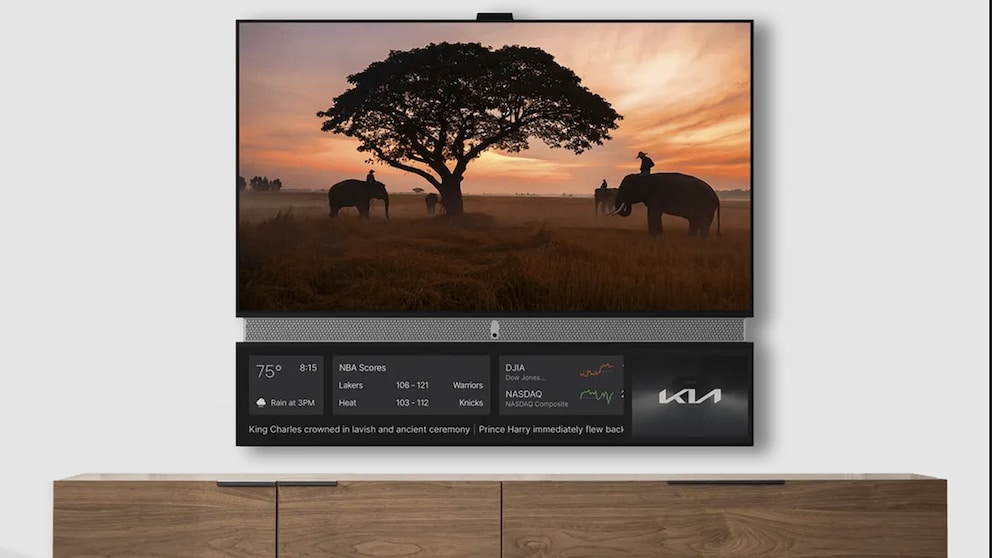
The Smart TV developed by Telly is the first dual-screen model on the market. The main TV has a 55-inch screen and supports 4K and HDR. Below the main display is a narrower and lower screen that can display various information such as sports scores, news, and weather, and can also control music or smart devices. This second screen can be dimmed if, for example, a movie is playing on the main TV.
The company believes that users will keep the second screen on even when the main TV is off–to access control and playback functions or additional data. This would also be a practical side effect for potential advertising partners: the ads displayed on this screen would remain visible at all times.
The two screens are connected by a premium soundbar with five drivers. The Telly TV also offers three HDMI ports for connecting additional devices. At least one TV stick is necessary, as the TV does not have its own system. Telly’s own Android-based operating system is only intended to control the TV’s advertising and interactive functions. Therefore, the device comes with a 4K stick with Android TV. According to Pozin, other TV sticks such as those from Roku, Amazon Fire TV, or Apple TV can also be connected. The TV is intended to be a hub for thousands of apps that users can access. It also includes a camera for video conferencing.
According to the manufacturer, the TV would cost around $1,000 in stores, but Telly delivers it free to interested parties. What does the company hope to gain from this, and where’s the catch?
Why Telly’s TV is Free
The company is offering the first 500,000 units of its TV for free. Delivery is scheduled for this summer. To get the free TV, interested parties must sign up on the Telly website. However, this is only available to users in the U.S.
Simply entering initial data such as name, email, and phone number is not enough. After filling out these fields, users are redirected to another page and prompted to download the Telly app for Android or iOS on their smartphone. Through the app, they must create an account, during which the manufacturer requests additional data. The questions also include personal information about the applicants. Telly then evaluates the responses and decides who among the applicants will actually receive a free TV.

It quickly becomes clear what Telly is after: user data. CEO Ilya Pozin is open about this and confirmed the fact in an interview with the American portal “FastCompany.” “We give away the device for free, and the entire business model is supported by our advertising, data, and affiliate revenue sources,” said the Telly founder. They know where users live, what car they drive, where they shop, and their income level–”of course, everything is anonymized,” Pozin said.
Read also: These TVs can no longer be sold

Amazon Fire TV, Roku, Google TV Streamer, and Apple TV: A Comprehensive Overview of Streaming Sticks

QLED, 8K, HDR, Micro-LED: What Do These TV Acronyms Mean?
Telly’s Strict User Requirements
The terms of use on the website also include a corresponding note on data collection and processing. “You must register for an account, select a password and username, and provide us with certain information or data such as your contact information,” it states. And further: “You promise to provide us with accurate, complete, and current registration information about yourself.”
Those who register and are selected for the free TV enter into a contract with the company, according to Telly. This includes using the Telly TV as the primary television in their household and not disconnecting it from the internet. Selling the device is prohibited, and users must also inform the company of any address changes. If they violate these conditions, they may no longer use Telly’s offer and must return the TV.
Read also: The best 4K TVs for a small budget
Free TV at the Cost of Privacy
In the end, a clear picture emerges: users don’t get Telly’s TV for free; they pay with their privacy. The device continues to collect data even during use. Telly tracks, among other things, which channels and programs users watch and sells the data anonymously to providers of various advertising apps. While TVs in Germany also have this capability, users can opt out of data sharing at any time. Telly explicitly does not offer this opt-out function.
After all, the trade in data and the resulting partnerships are the reason the company can offer the TV for free. This strategy recoups the manufacturing costs for the hardware. “We are very open and transparent,” Pozin explains. “Everyone knows what they’re getting into, what the value exchange is.”