

February 2, 2022, 12:42 pm | Read time: 4 minutes
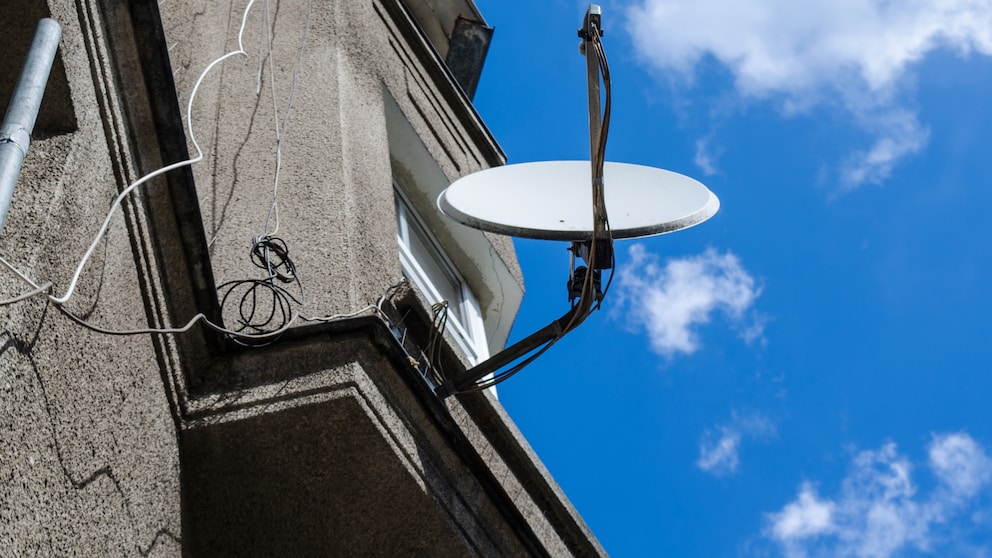
Is the TV picture fuzzy? Then the satellite dish might be misaligned. TECHBOOK explains how to easily fix this.
Even though antenna television experienced a resurgence in Germany with the introduction of DVB-T2 HD, most people still prefer watching TV via satellite dish. According to Statista, this still accounts for between 45 and 50 percent of households that receive television.
The advantages are clear: Apart from the dish and a receiver, costs are low, and the program selection with satellite TV is extensive. However, it can be annoying if the satellite system is not properly installed or aligned on the roof, leading to frequent reception issues. TECHBOOK shows how to properly align the dish.
Mounting the Satellite Dish
First, check whether the dish should be mounted on the house wall or the roof. In a private house, there are usually no issues–in a rental apartment, however, you must ask the landlord for permission. If the dish is to be mounted on the house wall, ensure that no trees or neighboring walls block the signal–this is one of the most common causes of interference.
Only if there is truly no suitable spot on the house wall should the dish be mounted on the roof. This installation is not only dangerous–for every adjustment or cleaning, you must also climb onto the roof.

Which TV Connection Is Right for Me?

Never Search for Channels Again? This New TV Standard Could Change Everything
Aligning the Satellite Dish
The most expensive satellite dish is useless if it is not properly aligned–the picture will be fuzzy, and there will be frequent disruptions. The big question in alignment is: In which direction should the dish point to receive the signal from the satellites orbiting in space?
Most households in Germany align their dish to the satellites at the Astra 19.2 degrees East position–they transmit not only public broadcasters but also many private channels, Sky, and foreign programs. But where exactly is 19.2 degrees East? First, it makes sense to roughly align the dish southward. If unsure, a compass helps–or a compass app, which is usually available for free for Android and iOS.
Here is an overview of the satellites receivable in Europe:
Astra 1 19.2° East: public broadcasters and private programs from Germany.
Astra 2 28.2° East: British and Irish channels like the BBC, as well as Austrian, Slovak, and Czech channels.
Eutelsat satellite system Hot Bird 1-6 13° East: public broadcasters and private programs from Germany, as well as channels from France, Poland, and Italy.
Türksat 1C 42° East: Turkish programs (analog and digital)
Then it’s time for fine-tuning: If you have a TV and the satellite receiver nearby, you can check directly on the screen–the receiver usually has a menu item that indicates how good the signal quality is in numbers or bars (this metric is more important than signal strength). If the picture is poor, slowly turn the dish to the left towards the east until the signal improves. Caution: The receiver shows changes with a slight delay. If the picture doesn’t really improve, adjust the tilt angle–slowly move the dish up or down.
Aligning works even better with the “SatFinder” app, available for iOS and Android. It uses GPS and the phone’s tilt sensor and provides a step-by-step guide to find the right position.
Once the dish is properly aligned, you only need to start an automatic channel search on the receiver–and a wealth of programs should be available.
Alternatives to the Satellite Dish
Flat Antenna
If you don’t want to place satellite dishes on your house wall or roof, there are numerous alternatives. For one, there are more discreet satellite systems that blend better into the surroundings while still offering the advantages of a satellite dish, such as the so-called flat antenna. This antenna is generally much smaller than a satellite dish and box-shaped. Unlike its large, dish-shaped counterpart, the antenna can be easily installed on a balcony, and the rectangular shape offers various camouflage options.
Satellite Antenna
The satellite antenna has the advantage of being able to be set up indoors. However, the window glass must not isolate the signal. The same alignment rules apply as with the satellite dish: always facing south.
IPTV
IPTV stands for “Internet Protocol Television,” meaning the channels are transmitted over the internet. It is the most modern way of receiving television.
Also interesting: How repeaters make Wi-Fi faster
Antenna Television
If aligning the dish is too cumbersome, you can also receive HD television with a regular indoor antenna since 2016. However, there are some things to consider: HD channels incur a monthly extra fee, and you also need new devices like receivers. TECHBOOK explains in this article what is needed for the switch.