

May 29, 2025, 10:27 am | Read time: 10 minutes
Few genres have shaped the gaming industry in recent years as much as–but also divided it like–open world. Titles with open game worlds entice with massive maps and countless hours of gameplay. But what exactly defines open-world games, and which ones are worth recommending?
Open-world games were long considered, especially in the 2010s, the ultimate in gaming. Hardly any AAA title came without a vast game world brimming with quests, loot, and breathtaking landscapes. However, these elements, often touted as strengths, are also the genre’s weaknesses. Nevertheless, there are numerous open-world games that the TECHBOOK editorial team believes are must-plays.
Open-World Games and Open Game Worlds Explained
The essence of open-world titles is in the name: an open game world. This term is somewhat misleading because, due to technical limitations, no game world is truly completely open. What these games share, however, is a certain size of their game world, where players can move almost freely, and whose quests and stories are, in almost all cases, highly non-linear.
Players have a lot of freedom in how and in what order they tackle tasks, thanks to the freedom of movement these titles offer. Exploring the game world is also a crucial part of open-world games. Another feature is the minimal occurrence or even complete absence of loading screens.
Recently, however, open-world games have also faced increasing criticism. “Too full,” some say. “Too meaningless,” say others. But the general accusation against many large studios in this context is that open worlds become an end in themselves and a justification for size, ultimately becoming an expensive affair for everyone involved. Nevertheless, there are many open-world titles that are absolutely worthwhile and whose game worlds should be visited at least once.
The Elder Scrolls V: Skyrim

The “Elder Scrolls” series is one of the most renowned in this field. As early as 1996, developer Bethesda released the second installment, “Daggerfall,” with a game world that still sets standards in terms of size. Thanks to randomly generated content, the title reportedly covers an area of 480,000 virtual square kilometers. The successors no longer reach these dimensions. However, parts like “Morrowind” and “Oblivion” still have many fans today–especially thanks to their open worlds, as the remastered version of “Oblivion” recently proved once again.
However, the fifth installment of the series, released in 2011, is for many the epitome of the open-world genre. “Skyrim,” the game’s title, refers, like its predecessors, to the setting, which in this case encompasses the northernmost region of the game world called Tamriel. The landscape there is characterized by snow-covered mountains, an icy coast, dark forests, and vast plains. As the so-called Dragonborn, the player must use their unique talent to eliminate the threat posed by the returning dragons. At the same time, a fierce civil war rages in Skyrim (translated as “Himmelsrand”).
The strength of “Skyrim’s” game world lies partly in the complexity of its topography. Additionally, Bethesda fills this world with all sorts of life. Yes, the quests can be repetitive and generic, but boredom is not an issue in Himmelsrand. Many details contribute to this, both manually and randomly created. A meditating wizard in solitude, an entertaining drunken brawl in the corner of a tavern–”Skyrim” rewards its players like few other titles for exploring the game world with open eyes and simply enjoying it.
The Legend of Zelda: Breath of the Wild
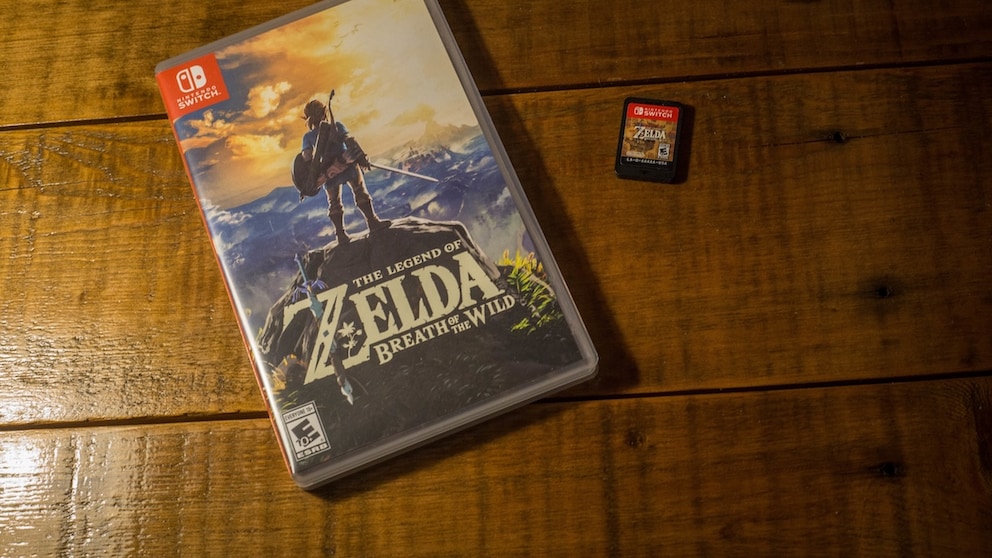
In 2017, Nintendo not only released its new Switch console. Alongside it came the title “The Legend of Zelda: Breath of the Wild,” perfectly tailored to the new hardware. The success of one was certainly instrumental in the success of the other. Moreover, Nintendo not only revitalized its console division with the Switch but also took an uncharacteristically bold step with “Breath of the Wild.”
Not in the storyline–this is typically Zelda, boiled down to the same spartan pattern. The hero Link awakens after 100 years of healing sleep to continue the battle against the Calamity Ganon and rescue Princess Zelda. For this, Nintendo relies on an impressive open world, which is almost unique in its potential freedom of movement.
Also interesting: These are the funniest Easter eggs in video games
Those who fully exploit the game’s mechanics can explore almost every corner of the game world Hyrule. The hero Link can–with the right equipment and enough resources–climb any mountain and swim through any lake. The focus on the game world is also emphasized by the fact that, besides the already sparse main quest, there are hardly any side quests in the usual sense.
That’s not necessary either, as Hyrule offers plenty of other incentives. The Sheikah Towers reveal more parts of the map, shrines allow players to solve puzzles and improve their resources, and with enough Korok seeds, players can expand their inventory and much more. The game world is the star and the center of “Breath of the Wild”–a concept that was further expanded in the sequel, “Tears of the Kingdom.” It’s no wonder “Breath of the Wild” is considered by many not only one of the most impressive open-world games but also one of the best games of all time.
Red Dead Redemption 2
No list of recommended open-world games would be complete without at least one title from Rockstar Games. In this case, we’ve chosen “Red Dead Redemption 2” (apologies to all “GTA V” fans). What makes the very large and open game world in this title stand out is its realism and the high level of hand-crafted details.
The story is set twelve years before the first installment. The protagonist of the 2004 predecessor, John Marston, also plays a role in “Red Dead Redemption 2,” which tells the backstory. However, the new main character is the rogue Arthur Morgan, who in 1899 is part of Dutch van der Linde’s gang. After a botched robbery, the gang must flee and plans to finance this through a train heist. Unfortunately, they choose the train of oil magnate Leviticus Cornwall, who sends bounty hunters after them.
Arthur and the rest of the gang’s escape takes them across the country and even briefly to the Caribbean island of Guarma. Each “new” area is part of the massive map, with plenty to discover. What makes “Red Dead Redemption 2” so exceptional, in combination with the game world, are its complex characters. These are not only part of the main story. Even within side missions, players can meet many interesting people and experience stories. However, this requires a lot of time, patience, and the willingness to fully immerse oneself in this open-world game.
Assassin’s Creed: Origins
The “Assassin’s Creed” series by Ubisoft has evolved over the years, especially regarding the game world. The 2017 release “Origins” marks the most significant shift in this regard, although the predecessor “Black Flag” laid the groundwork for it. And even though Ubisoft is often criticized for its open-world formula, “Assassin’s Creed: Origins” offers so much good that it deserves a spot on this list.
Firstly, there’s the fundamental setting that fits the series like no other. “Origins” is set in ancient Egypt and explores the origins of the Assassin order. Endless dunes and rugged rocks, as well as the diverse and colorful Mediterranean coast, can be explored by the player. You take on the role of Bayek of Siwa, a so-called Medjay, who is tasked with protecting his people and avenging his son’s death.
Also interesting: What is the difference between computer games and video games?
He fell victim to a conspiracy by the ominous “Order of the Ancients,” which pulls the strings behind the scenes in Egypt. In typical “Assassin’s Creed” fashion, Bayek sets out to identify and eliminate the members of the order. To do this, he must travel the entire game world and ally with historical figures like Cleopatra, who is vying for the throne with her brother Ptolemy.
From an open-world perspective, “Origins” does many things better than its predecessors. Primarily, the versatility of the topography and the high potential for exploration in an almost completely open game world are noteworthy. Cities like Alexandria are fully integrated into their surroundings and visible from afar, with hidden temples possibly waiting behind every dune. This–combined with beautiful graphics–makes “Origins” one of the best open-world games.

The 5 Best Open-World Games for Extensive Exploration

Highlights to Expect at Gamescom 2023
The Witcher 3: Wild Hunt
What “The Witcher 3: Wild Hunt” is at its core is often debated. However, it is clear that it has a fantastic open world. The game is based on the “Witcher” novels by Polish author Andrzej Sapkowski and was released by CD Projekt in 2015, following its predecessors in 2007 and 2011.
In a medieval Slavic fantasy world, players fight as the witcher Geralt of Rivia against monsters of various forms. However, his main goal is to find his adopted daughter Ciri, who is being pursued by the Wild Hunt due to her special abilities.
“The Witcher 3” takes players on this quest to nearly every corner of its game world. In addition to the large main areas of Velen and Novigrad, it offers the rugged Skellige Islands, the witcher fortress Kaer Morhen nestled in alpine mountains, and the DLC “Blood and Wine” adds the colorful duchy of Toussaint.
The great strength of “The Witcher 3” is the connection between the story and the open world. The latter always offers the promise that a new quest could be waiting around every corner. These quests benefit enormously from the detailed game world, which is characterized by various conflicts, military confrontations, and cultural differences.
Open-World Games Have Changed the Industry
At this point, many more great titles could be mentioned that boast a fantastic open world. For many, the aforementioned “Grand Theft Auto V” is the best representative of its genre. “Elden Ring,” one or another “Fallout” installment, “Kingdom Come Deliverance (2),” “Ghost of Tsushima,” “Death Stranding”–this list could go on endlessly. It shows that open-world games are often better than their reputation, which has somewhat suffered in recent years.
This is likely due to an imbalance; open worlds were omnipresent for many years. However, it must be noted that open game worlds, thanks to increasingly sophisticated technical possibilities, have had a lasting impact on the video game industry and continue to do so today.
In a way, they push one of the medium’s most essential features to the limit: interactivity. When a game world is added that can convince with beauty, but above all with meaningfulness, and that doesn’t place its content just for the sake of it, but asks what makes sense and why it should be in that specific place, then truly good games emerge.