


August 17, 2022, 3:03 pm | Read time: 10 minutes
In the fiercely competitive console market, four major brands have now established themselves. We’re talking about Sony, Microsoft, and Nintendo with their PlayStation, Xbox, and Switch consoles, as well as Valve’s Steam Deck. But which gaming console suits whom? TECHBOOK makes the comparison.
Consoles offer mobility and flexibility. On average, they are also significantly cheaper than a gaming PC. While PCs led in performance and graphics for many years, this is no longer as pronounced today. The fact is that the number of PC gamers has been declining for several years, while the number of those who prefer to play via console is steadily increasing. This is evidenced by recent surveys from the German Games Industry Association.
However, anyone buying a console must fundamentally decide which device it should be–and especially from which manufacturer. Switching later becomes increasingly difficult, as games are often tied to a specific platform and console. TECHBOOK compares the four major console series–PlayStation, Xbox, Nintendo Switch, and Steam Deck–and explains which is suitable for whom.
Also interesting: How gaming characters could look in reality
Overview
Nintendo Switch is flexible and family-friendly
Nintendo is far from new to the console business, but with the Switch, the company has taken a completely new path. The Switch is a hybrid device that–except for the Lite version–features both a stationary and a handheld mode. It’s possible to play via the docking station on a large screen or on the smaller, built-in display of the console.
This is possible, among other things, due to the Joy-Cons, the external control elements of the Switch. These mini-controllers can be attached to the sides of the console, placed on an adapter, or held loosely in hand. Nintendo has also adapted many of its own games, such as Nintendo Switch Sports, to this control system. For example, in the game, it’s possible to mimic the motion of a tennis serve to execute it digitally. With a Switch, it’s also possible to subscribe to the Switch Online service.

There are now three versions of Nintendo’s console: the “normal” version, the Switch Lite, and the Switch OLED. This makes a price difference of up to 100 euros. The individual models differ in their battery life, internal storage size, and display size. The Nintendo Switch Lite lasts up to seven hours in operation, has 32 GB of storage, and a screen diagonal of 5.5 inches. It can only play games in handheld mode and is not compatible with a docking station. The Nintendo Switch OLED, on the other hand, lasts up to nine hours and features 64 GB of storage and a 7-inch display.
Compared to PlayStation, Xbox, and even Steam Deck, the Switch can’t quite keep up. However, its major advantage is clearly its flexibility. Many Nintendo games like “Animal Crossing: New Horizons” or “Zelda: Breath of the Wild” are also released exclusively for this console. And perhaps the biggest plus: Due to lower barriers and graphical requirements, many small developer studios publish through the Nintendo eShop. While not particularly user-friendly, it contains many lesser-known indie titles.
Also interesting: How to properly clean a gaming console
Valve Steam Deck for PC gamers
While the selling point for the Switch is primarily Nintendo’s own game offerings, the Steam Deck scores with access to the world’s largest gaming platform. Valve’s console is primarily optimized for the extensive selection of triple-A and indie titles in the Steam Store. Big names like “Elden Ring,” “Cyberpunk 2077,” and “Red Dead Redemption 2” require a lot of power–and the Steam Deck delivers that compared to the Nintendo Switch.
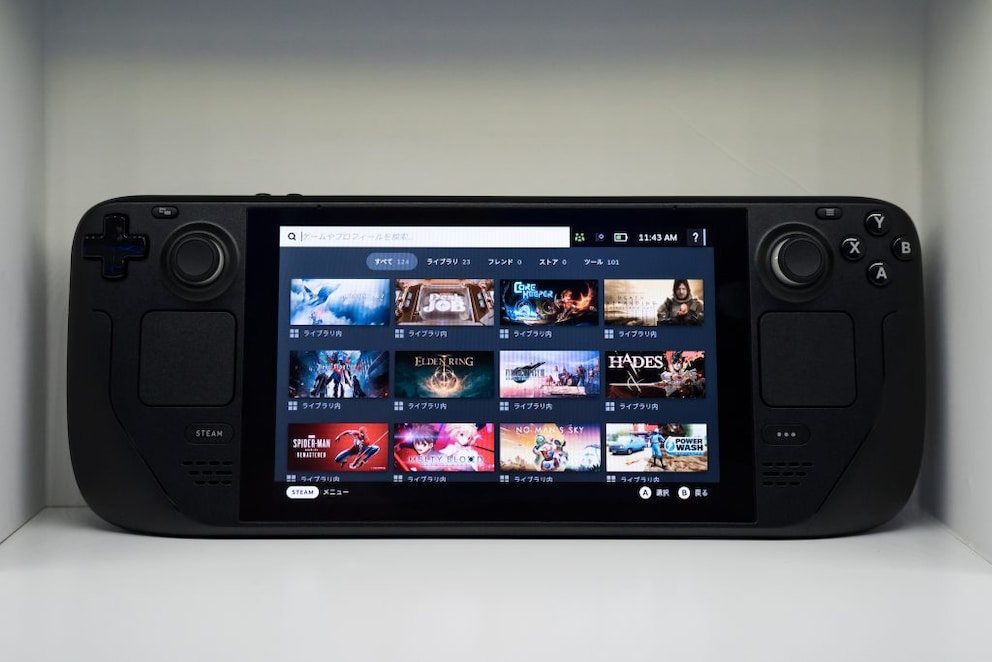
The console houses a 4-core CPU and a GPU, partially custom-made by AMD to Valve’s specifications. It also includes 16 gigabytes of RAM and, depending on the configuration, 64, 256, or 512 gigabytes of internal storage. Note that the 64-GB version uses slower eMMC storage, while the other models come with NVMe SSDs at PC level. With these specifications, the Steam Deck is quite comparable to laptop hardware. However, the graphics unit offers more power than many mid-priced ultrabooks, which often only come with an integrated GPU (iGPU). Still, the Deck is significantly more compact–though not as compact as a Switch.
The Steam Deck runs on the Linux-based SteamOS, which is both the console’s greatest strength and a weakness. Valve’s self-developed platform can run games originally developed for Windows on the device through the compatibility layer “Proton.” Valve certifies games that have been tested and found compatible with a green checkmark for the Steam Deck. The problem is that many titles are either not sufficiently tested or simply not compatible. However, with some tinkering and experimenting with experimental Proton versions, almost any game can be made to run.
This is another strength of the Steam Deck, as the console offers countless possibilities and ways to play. Not only can you stream games in better quality from a gaming PC to the Deck, but alternative stores can also be installed via the desktop mode. The Deck can also be connected to a TV or monitor, similar to the Switch, to enjoy games on the big screen. However, the hardware limitations become apparent here–especially compared to the PlayStation, Xbox, and even the Switch. For screens other than the built-in display with 1280 x 800 pixels, settings must be lowered to achieve smooth gameplay.
Who is the Steam Deck suitable for?
With access to the Steam library, gamers who already use the program on their gaming PC will get their money’s worth. The console is powerful yet portable and even offers expansion options, such as for a microSD card and even the internal SSD. However, for beginners, there is potential for frustration, as not everything may work right away. With a base price of 419 euros, the Steam Deck is slightly more expensive than the Switch but significantly cheaper than handheld consoles in this performance class–such as those from Ayaneo or GPD.
Microsoft’s Xbox for pro gamers
Since the first Xbox hit the market in 2001, much has changed at Microsoft. The console series now includes four generations. The current models are called Series X and Series S, with S marking the stripped-down version. The models are priced 200 euros apart. Generally, an Xbox provides access to Microsoft’s GamePass.
An Xbox–regardless of the model–is especially worthwhile if you like to play on large screens, as the console is a true graphics marvel. The current Series X even enables gaming in 8K. The Series S does not offer this, and it also lacks a drive to play DVDs and Blu-rays. This is possible with the X version. Otherwise, the two consoles differ in their storage size–512 GB vs. 1 TB–and the performance of the GPU.
Especially compared to the Switch and even the PlayStation, the Xbox’s graphical performance is noteworthy. Particularly the Xbox Series X is, on paper, the most powerful console–and it shows. Another major advantage is the backward compatibility of Microsoft consoles. Even titles for the Xbox 360, released in 2005, are still playable on the current models.

The Most Expensive Xbox Ever Is a Handheld Console

Valve Steam Deck — Functions, Advantages, and Evaluation
PlayStation as a powerful all-rounder
Current sales figures clearly show that Sony offers the most popular console with its PlayStation. The PS4 has sold more than twice as well as the Xbox One. The current generation includes two editions of the PlayStation 5, which are arguably the most visually striking consoles presented so far. While the Xbox comes in black and stands out, and Nintendo only sets accents with the colorful Joy-Cons, the PS5 is not only strikingly tall (39 cm) but also stands out visually with its white color and somewhat futuristic proportions. The Slim and Pro versions of the PS4, released in 2016, are much more understated in this regard. Regarding the PS5, the visually matching DualSense controller is also worth mentioning.
The PlayStation 5 is also available in a version with and without a drive, allowing the playback of DVDs and Blu-rays. The performance difference between the two consoles is significantly smaller than with the Xbox Series X/S. Older models like the PS4 (Slim and Pro) can also play movies.
Also interesting: 23 PlayStation games set to release in 2023
In terms of performance and speed, Xbox and PlayStation are not far apart, especially in the current generation. Even though Microsoft has a slight edge, the PS5 can also resolve in 8K with an appropriate screen and has nearly identical GPU and CPU values, albeit with slightly less storage at 825 GB. Compared to the Xbox, the PlayStation has significantly more exclusive titles. Even major new releases are sometimes only playable on the PlayStation for months after release before they land on other consoles.
Also interesting: The PlayStation 5 and Xbox Series X in direct comparison
Which gaming console is worth it for whom
The question of which console is ultimately suitable for which need is both very simple and, of course, difficult to answer because it is very individual. However, some essential aspects can be broken down in the comparison of consoles.
For instance, Nintendo’s Switch is suitable for Nintendo fans, as many of the company’s games are exclusively available for its own console. Additionally, the handy Switch is well-suited for children; the interactive concept of the Joy-Cons is also very suitable for families who want to play together. Another big plus of the console is that it provides access to many unknown small indie titles. It’s worth browsing for experienced players as well. However, the graphical performance and cinematic effect lag behind the competition.
The Steam Deck is primarily aimed at gamers who want access to the games in their Steam library on the go or on the couch. The console is powerful yet portable and even offers expansion options, such as for a microSD card and even the internal SSD. However, for beginners, there is potential for frustration, as not everything may work right away.
Particularly demanding players are therefore well-advised with the Xbox. The current Xbox Series X is a good choice in terms of performance and graphics. There are also some exclusive titles for this console series, such as “As Dusk Falls.” Additionally, an Xbox is broadly backward compatible, so you can also play older games on it. However, the selection is generally smaller compared to the PlayStation or Switch. The current model is also sometimes difficult to obtain due to supply chain issues.
Sony’s PlayStation offers many the all-around carefree package. The selection of titles is immense, although less surprising than with the Nintendo Switch. However, all major games usually end up on the PlayStation sooner or later. The latest models, like the PlayStation 5, also meet high graphical demands. However, the PlayStation 5 is still only available in limited quantities, and there is already an expiration date for the previous generation. Comprehensive backward compatibility is only secured with the PS5.