


September 6, 2025, 12:56 pm | Read time: 4 minutes
Samsung brought its new Odyssey 3D gaming monitor to IFA 2025. The specs sound like a dream: 27 inches, 4K resolution, 165 hertz, and 3D? Gamers can finally immerse themselves completely in the game world–or so one might think. In reality, the monitor is as gimmicky as ever. I now doubt that the vision of true 3D gaming can be realized with conventional means.
3D displays, along with transparent TVs, are a cornerstone of IFA. Every year, manufacturers bring new concepts, prototypes, and occasionally even functional retail units to the show. This year, Samsung has its Odyssey 3D G90XF, which was introduced in March 2025 introduced. I saw the monitor for the first time at IFA. As a longtime 3D enthusiast, I had to try it out immediately. My conclusion: The technology has come a long way but is heading straight into a dead end.
3D? Yes, please–but not as a monitor
As a tech enthusiast, I’m generally optimistic that technological progress can improve our lives. I never owned a Nintendo 3DS–the first device to make 3D truly mainstream. The rise of 3D cinema at the same time seemed groundbreaking to me back then. If only it weren’t for the clunky glasses–extra inconvenient for me as a glasses wearer. When LG made 3D technology accessible to smartphone users with the Optimus 3D–without glasses–I had to jump on board. Seeing my own photos, videos, and even Android games in 3D impressed me so much at the time that I overlooked the eye strain. Just a few years later, I bought my first VR headset–the Oculus Rift. Currently, I use the Meta Quest 3 and am convinced that standalone VR headsets are the better way, at least for now.
Read also: What is the difference between virtual, augmented, and mixed reality?
Odyssey 3D is technically impressive …
That doesn’t mean the technology level in the Odyssey 3D isn’t impressive. A 4K gaming monitor with 165 hertz is among the best on the market. The 3D function is also not comparable to earlier attempts like the 3DS and Optimus 3D. Samsung uses eye-tracking, with two cameras integrated into the frame tracking where the user is looking. The monitor dynamically adjusts its image output to the viewing angle, so the 3D effect isn’t lost when you move your head. Additionally, no special 3D content is necessary. Samsung provides the Odyssey 3D Hub software, which, thanks to AI support, converts 2D videos into three-dimensional content. The hub also includes 3D games compatible with the monitor. According to Samsung, some 2D titles can also be converted.


What is the difference between VR, AR and MR?

What’s Behind Apple’s Mixed-Reality Headset Vision Pro
… but gives me eye strain
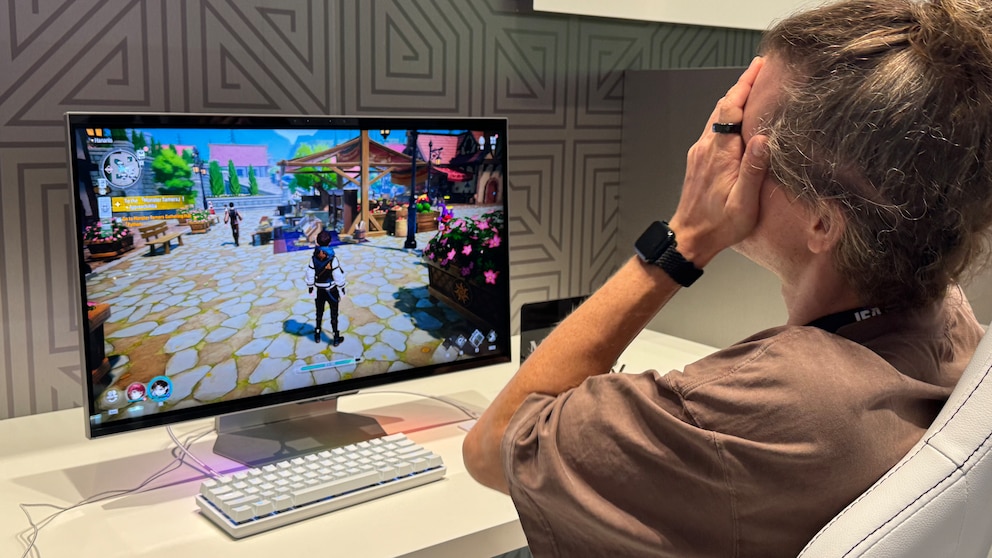
When I spotted the monitor at Samsung’s booth, I had to try it immediately. But just as quickly as I was excited about the new experience, the disillusionment set in. The 3D effect is indeed convincing, with multiple layers clearly standing out from each other. But it was so tiring to look at the monitor that I had to stop after a few minutes. Every time leaves flew across the screen in the foreground, my eyes couldn’t focus quickly enough. The contrast between the foreground, middle ground, and background was simply too strong. I had trouble concentrating on the game character.
Mixed reality is the future
Even the advanced 3D technology with eye-tracking in Samsung’s 1,759 euro Odyssey 3D has physical limits. But that’s precisely the problem: 3D display technology is a dead end. No matter how high-resolution the panels and how precise the eye-tracking–the limiting factor will always be the form factor itself. In my opinion, small, portable mixed-reality headsets are the future. At least until we can project digital images directly into our brains. Whether we really want the “Total Recall” future is another question.