

September 13, 2026, 8:02 am | Read time: 6 minutes
If you actively experienced the 1990s, you likely didn’t miss Microsoft Solitaire–hardly any other game was found on so many computers at the time. While today’s blockbuster computer games are often associated with photorealistic graphics, gigantic game worlds, or cinematic cutscenes, Solitaire has none of these–and yet it remains one of the most well-known computer games of all time. TECHBOOK explores how the simple digital version of a basic solo card game became so successful.
The inspiration for the cult computer game Solitaire was classic patience games, which date back quite a while. It is believed that the card game was invented in the 18th century in Europe–possibly out of boredom by a French nobleman? This is noted on the portal “Patience.org.”
What is certain, however, is that the various patience variants spread increasingly throughout the 19th century. They quickly became a popular pastime, likely due to their easy availability and the ability to play them alone.
Computer Game Based on Klondike Solitaire
In German-speaking regions, the term “patience” became common for analog card games, while in English-speaking areas, “solitaire” was more often used. Microsoft later adopted a specific variant for its famous computer version: Klondike Solitaire, the most well-known form of the classic patience game. It is believed to have received its name during the gold rush in Canada’s Yukon.
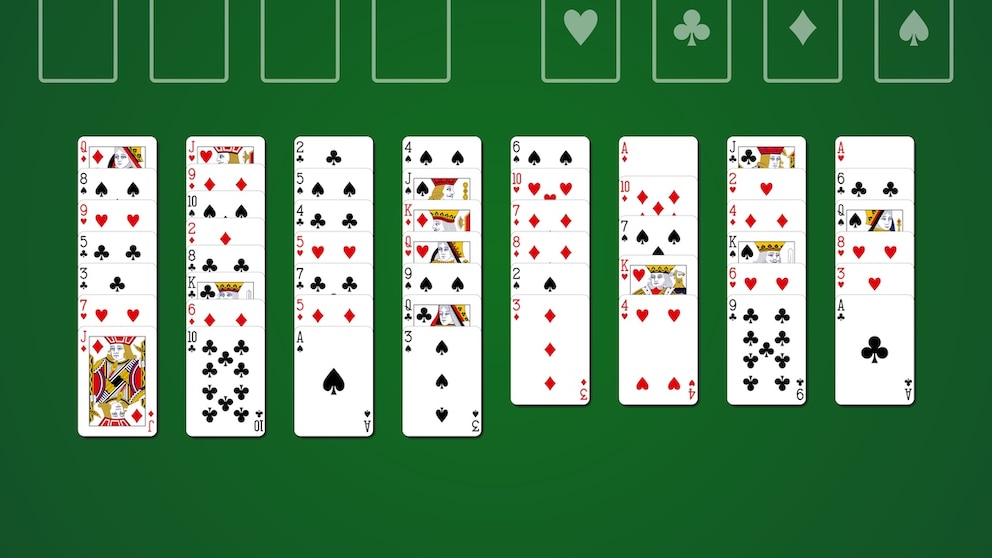
If you don’t know how the game works: You must sort all 52 cards onto four foundation piles, separated by hearts, diamonds, spades, and clubs, and each from ace to king. The seven tableau piles are built alternately in red and black and in descending order.
And now for an intriguing detail. As successful as Solitaire would later become, its creation was by no means a major strategic decision by Microsoft’s leadership. In fact, the story behind the cult game is no less interesting than the game itself.
Microsoft Intern Developed the Cult Game in His Spare Time
In 1988, Wes Cherry interned at Microsoft. As he recounted decades later in a discussion on Reddit, he programmed Solitaire in his spare time for Windows 2.1. He was inspired by a similar version on the Macintosh that he had played during his studies.
The biggest challenge at the time, he explains, was not the game idea but the technology. The graphics hardware of the late 1980s was so slow that even smoothly dragging a card across the screen required extensive optimization. Through an internal Microsoft game collection, the program eventually made its way into Windows 3.0 in 1990, becoming accessible to millions of PC users for the first time. In the following years, Solitaire evolved into a worldwide cult game that would accompany generations of computer users.
It is worth mentioning that graphic designer Susan Kare also played a significant role in Solitaire’s success. Specifically, she was responsible for the iconic appearance: She designed the famous Solitaire playing cards for Windows.
Creator of Solitaire Didn’t Receive a Cent
For Microsoft, Wes Cherry was a real stroke of luck. The company keeps the cult game alive to this day and, of course, profits from it. Cherry himself, however, did not benefit from Solitaire’s later success. According to him, the former intern only received an IBM-XT computer, which he could use during his time at Microsoft to fix bugs in the game. Royalties? None.
So, Solitaire was created. But why did it become such a massive hit?
Reasons for Solitaire’s Mega Success
The appeal of Solitaire likely lies in the same qualities that made classic patience games popular. You play alone, the rules are understood within minutes, and the first successes come quickly. Each game is different, providing variety.
Also interesting: “How ‘Tony Hawk’s Pro Skater’ Changed My Life 25 Years Ago”
Solitaire does without much of what defines modern games today. There is no opponent, no time pressure, and no complicated menus. This calmness is likely a key part of its success. A round often lasts only a few minutes, yet a won game feels like a small victory.
Speaking of success, the digital version enhanced this feeling further–with an animation that was remarkable at the time. Winning a game rewarded you with a small victory fireworks display: The cards jumped across the screen and bounced seemingly chaotically downward. These special effects, which became one of the most famous visual trademarks in Windows history, made each won game a bit more special and enticed players to play more. But, of course, you also lose sometimes, and even then, there’s an incentive to play again.

Bizarre! These Absurd Devices Can Run “Doom”

Bill Gates and the Story Behind Microsoft
Game and Learning Program
Today, graphical user interfaces are commonplace. But imagine going back to the early 1990s–the concept was still entirely new to many people. Mouse control, clicking, drag-and-drop… all unfamiliar actions that had to be learned. Solitaire played a surprisingly significant role in this. By moving the cards with the mouse, users learned to use the computer playfully. They gained practice in clicking on objects, moving files, managing windows, and precisely handling the mouse pointer.
Appropriately, the office became the stage for Solitaire’s great triumph. In the 1990s, many office computers ran Windows–and thus Solitaire was often pre-installed. This also led to the game gaining a bit of a reputation as a productivity killer over time.
Solitaire Ages Well
In 2019, Microsoft Solitaire was inducted into the Video Game Hall of Fame–an honor that underscores the game’s lasting impact on video game culture. Its continuous development also contributed to this success. Over the years, Microsoft added variants like FreeCell, Spider, Pyramid, and TriPeaks to the classic Solitaire. Since Windows 10, these variants have been included in the Microsoft Solitaire Collection. The game can now be expanded, if desired, with daily challenges, achievements, and online statistics.
Thanks to its availability on PCs, smartphones, and tablets, Solitaire remains one of the most popular computer games worldwide. On the 30th anniversary of the cult game–which was in 2020–Microsoft reported more than 35 million active players per month from around 200 countries.
Unlike many other classics, Solitaire does not feel outdated even after decades. The game doesn’t follow trends and doesn’t require elaborate updates to function–not even the internet. In a world full of live-service games and constant innovations, the appeal may lie in the fact that Solitaire simply remains what it has always been: a calm, timeless card game.