

January 28, 2026, 4:18 pm | Read time: 8 minutes
Today, Pokémon is one of the most influential and best-known gaming franchises in the world. At the time, its success came as quite a surprise. TECHBOOK provides an overview of the remarkable history of the series.
Pokémon is all about one thing: “Gotta Catch ‘Em All.” This means that you have to catch as many different pocket monsters as possible. These can be found everywhere in the game world of the successful series. The monsters triggered an international hype that continues to this day. But how did it all come about, why is the series so successful, and how has it shaped the entire industry?
Surprising Success in the 90s
Fans around the world celebrate Pokémon Day on February 27. This is because the very first Pokémon game was released in Japan on this day in 1996. As Nintendo and video game developer Game Freak could not have foreseen its success, the company only released 200,000 copies. The actual sales figures then exceeded all expectations.
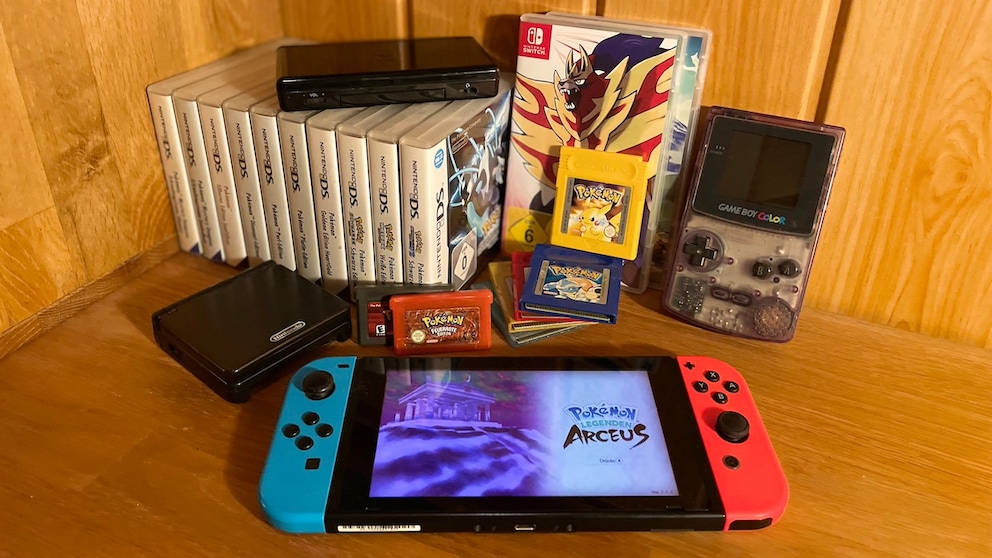
This success was not only hugely important for Nintendo in its battle with Sony for gaming supremacy, but also for the manufacturer’s already moribund console: the Game Boy. This had actually already been replaced by the N64, and the concept of the handheld console had been declared a failure. The man behind Pokémon was the then 30-year-old game developer Satoshi Tajiri. The passionate insect collector adapted his hobby and, together with his friend Ken Sugimori, created 151 sometimes cute but also strange pocket monsters for the Game Boy in his first attempt.
The first games in the series are the “Red Version” and the “Green Version.” If you wanted all the monsters, you had to buy both games—a trick that worked and still does today. However, the final breakthrough came with the “Blue Version,” which also featured slightly improved graphics. In Germany, “Pocket Monsters” was first heard of at Space World 1997. The games were then released in Europe in 1999, having already been very successful, primarily in Japan.
Nintendo Established Pokémon on Multiple Fronts Early on
What followed was, first and foremost, very clever marketing. Because Nintendo didn’t “just” leave it at video games. As soon as the success of the Pokémon games became apparent, the company capitalized on players’ passion for collecting and launched a card game worldwide. In the USA, for example, the company worked with well-known publishers such as Wizards of the Coast, which had already enjoyed great success with “Magic: The Gathering.”
The anime series based on the games, which has been broadcast since 1997, was at least as important for further success. It follows the teenager Ash Ketchum, who aspires to a career as a Pokémon trainer. The series, in turn, laid the foundation for the equally hugely successful “Yellow Version,” which was launched in Japan in 1998.

Pikachu Conquers the World
Speaking of the “Yellow Version,” this version put the spotlight on a Pokémon that remains the face of the franchise to this day. We are talking about Pikachu. The little monster with a lightning tail already helped the anime to success. There, the Pokémon is Ash’s unruly companion with a strong character, with whom he builds up a close friendship over the course of the seasons. However, Pikachu was far from being the first Pokémon, just like the other well-known starters: Bulbasaur, Squirtle, and Charmander. Instead, the rhino-like Rhyhorn was the first to be introduced to the world.
In 1999, the first generation of Pokémon games was followed by the second with the “Golden” and “Silver Versions.” These introduced 100 more pocket monsters as well as a new region, Johto. The previous titles were all set in the Kanto region, which is based on the real area of the same name in Japan. Johto, on the other hand, is based on the real-life model of the Kinki region.
In 2000, the second generation was supplemented by the “Crystal Version.” In this version, players were not only able to choose a female avatar for the first time. With Suicune, a legendary Pokémon was also placed at the center of the story for the first time. Such Pokémon are unique, usually have special powers, and are closely linked to the growing mythology of the game world.
The latter is another key factor in the game’s success. Nintendo and Game Freak have continued to expand the story of the game’s origins and the creation of legends from game to game. In doing so, Pokémon created something that was subsequently copied by many other companies: an internationally functioning and cross-generational media phenomenon with clever multiple exploitation across many platforms and media forms.
Pokémon Spans an Impressive Nine Generations
The third generation followed in 2002 with “Pokémon Ruby” and “Sapphire,” followed by the fourth in 2006 with “Diamond” and “Pearl.” In 2010, the “Black” and “White Versions” were released, making it the fifth generation. The sixth includes “Pokémon X” and “Y,” which were launched in 2013. The successors ‘Sun’ and ‘Moon’ (2016) form the seventh generation, while ‘Sword’ and ‘Shield’ (2019) are the eighth generation.
We are currently in the ninth generation, released in 2022, with the main games “Scarlet” and “Violet.” Nintendo and Game Freak have never deviated from the fundamentals of their successful concept over the years, but have introduced smaller innovations with each generation.
Firstly, in the form of new regions and, of course, Pokémon. On the other hand, with mechanics and graphics. It’s no longer “just” about collecting the monsters. You can cook for them, give them gifts, and breed them.

FIFA 19, Pokémon, and Super Smash Bros. Ultimate Played for the First Time

Pokémon Cards That Are Worth a Fortune
A Series in Transition
There are now also various spin-offs. Games such as “Pokémon Mystery Dungeon” or “Master Detective Pikachu” rely on completely different concepts. In the former title, for example, you play a Pokémon yourself, while the latter relies more on an actual storyline, which was always rather secondary in previous games in the series. With the 2022 release of “Pokémon Legends: Arceus,” released in 2022, the series also slowly ventured into the realm of action role-playing games.
The mobile game “Pokémon Go,” launched in 2016, also ensured widespread success. With the help of real-time GPS, the title brings catching the popular monsters to reality for the first time. Players can find the Pokémon virtually in their own neighborhood.
The Unique Success of Pokémon
There are now also movies, theme parks, and a range of merchandise. Nintendo has managed to establish its Pokémon brand in many sectors, making it as broad-based as possible. Development never stands still; the brand always adapts to current circumstances without neglecting its core. Pokémon has thus shaped the gaming industry in particular. Whether handheld consoles, for example, would be as successful today without the resounding success of that time is questionable.
The German original of this article was published in February 2025.