



June 14, 2023, 1:20 pm | Read time: 4 minutes
They were especially popular in the past–call-by-call prefixes that allowed Telekom customers to make cheaper calls within Germany and abroad. As more users opt for mobile over landline calls, these cost-saving prefixes have faded into obscurity. Now, the end of call by call has been sealed.
It was THE phone trend in the early 2000s: With the so-called discount prefixes, also known as call by call or callthrough, Telekom customers could save significantly on domestic and international calls by using a special number combination. The call was routed through an alternative provider rather than the usual phone company. This method was introduced by lawmakers in 1998 to prevent Deutsche Telekom’s monopoly and offer users alternative rates. What many don’t know: These discount prefixes still exist today. However, their end is now sealed.
Overview
Call by Call Ends in 2024
With the lifting of the monopoly on voice telephony services in 1998, Telekom was required to offer call by call to its customers in the interest of competition. This obligation expired in 2019. Since then, Telekom has voluntarily extended the cost-saving prefixes after negotiations with the Association of Telecommunications and Value-Added Service Providers (VATM). But that will soon end.
Telekom landline customers can only use the cost-saving prefixes until the end of 2024, according to VATM. At the same time, from 2025, the handling of expensive special numbers is set to be simplified. Numbers starting with 0900 will then be billed “uniformly and transparently,” meaning that the costs for calls from landlines and mobile phones will be the same. Currently, mobile prices often deviate upward. Additionally, the price announcement before the call will remain for special numbers.
Read also: A new law fundamentally changes telephony
How Call by Call Works
Telekom is the only company in Germany offering call by call. Customers can use the cost-saving prefixes exclusively from landlines to make cheaper calls domestically, internationally, and to mobile networks. In principle, call by call is available everywhere, except in areas where the company has not laid its own lines and must rent them from other providers.
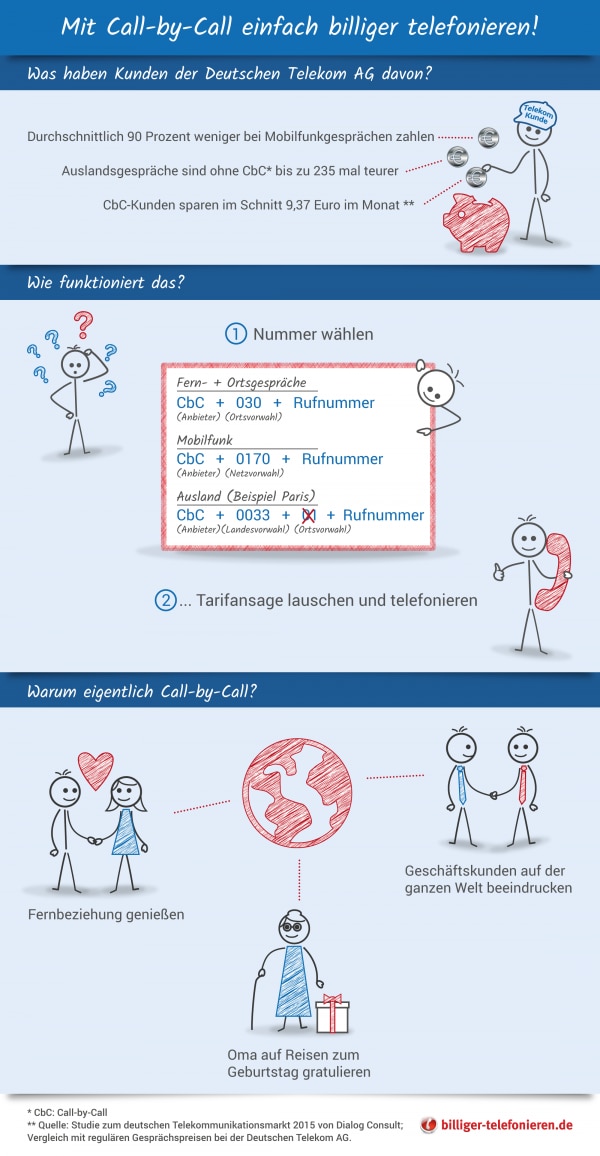
How call by call works is illustrated in the following infographic. Notably, until a change in telecommunications laws in 2012, call-by-call providers were not required to inform users of the applicable rate via announcement. Previously, users risked incurring enormous costs unknowingly, but now they are informed in advance of the cost of the upcoming call. The call is then billed through the regular phone bill.
Read also: 4 tips to save money on international calls
Users can check various internet portals to see which prefix is best for which purpose. Especially abroad, call by call can make a difference of over one euro per minute. Even though Telekom is increasingly switching to all-IP connections instead of analog and ISDN, the legal regulation still requires the company to offer call by call after more than 25 years. Those who are not Telekom customers cannot use call by call. Other providers do not have this option, as they have not been legally required to do so. For this, especially for mobile users, the callthrough principle is more suitable.

Calls from landlines to cellphones can quickly become a costly trap.

Do you still have a landline phone?
Callthrough Differs from Call by Call
With callthrough, users are not tied to a landline and can make calls from any device to anywhere. The process works similarly to call by call but has a few peculiarities that users should consider and evaluate. They must first dial an access number and then get a free line connected. After that, they dial the actual phone number.
Certain phone providers prohibit the use of callthrough in their general terms and conditions. Since customers make calls through a callthrough provider’s phone computer rather than their contractual provider, companies want to counteract huge savings with the ban.
If your provider allows callthrough, you can decide which payment model to use. For one-time calls, prepaid with rechargeable credit is suitable. For frequent calls, postpaid with billing through the regular phone bill is more appropriate.
Also interesting: With these providers, you can make the cheapest calls outside the EU
Avoiding Cost Traps
Finally, users should pay attention to which callthrough number is best for them. Comparison portals not only show which provider offers the best price for their interests but also list whether it has a rate announcement. This is crucial for callthrough, as prices can change and vary significantly depending on the time of day.
Moreover, the cheapest provider is not always the most reliable or the one with the best quality. Users should also weigh whether a regular call might be cheaper in the given situation. In other cases, they can save a lot of money with callthrough.
With material from dpa